
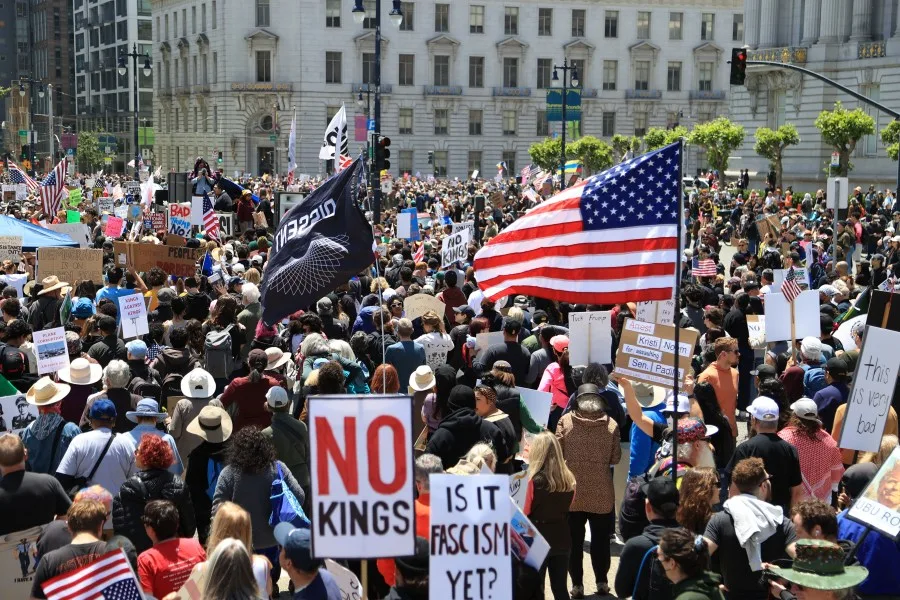
Millions of people marched and rallied in small and large cities and towns in No Kings protests on Saturday, March 28. Organisers reported that approximately eight million individuals participated in protests across 3,300 locations throughout all 50 states and U.S. territories. ABC News reported protests in several cities outside the US, including London, Paris and Rome.
The 3,300 locations were up from 2,700 last October. It was also significant that many took place in rural and suburban plazas and malls. Organisers told protesters to stay in their local areas. At the same time, major cities like New York, Philadelphia, Boston, Chicago, Los Angeles, San Francisco, and Seattle were exceptionally large and diverse. New York had three hundred fifty thousand people.

Protests were also organised across Florida, including near Trump’s Mar-a-Lago home and golf course, where he was playing. The protest was peaceful, as was true across the country.
The London event, titled Together Alliance March Against the Far Right, attracted half a million people, filling streets from Park Lane to Whitehall. The rally heard a speech from Jeremy Corbyn.
In the United States, over 500 groups organised the actions. They agreed to declare the flagship protest would be in St. Paul, the capital of Minnesota, where over 200,000 people marched and rallied. California held some 350 events.
Across the country, there were creative signs like the one in New York City: “Resist Like It’s 1776.” Hand-drawn signs cited affordability concerns as rising gasoline and food prices – accelerated by Trump’s trade war – along with health care costs. The Pentagon is paying $2 billion per day for war and seeking another $200 billion, which won’t bring any relief from inflation for ordinary people.
Resistance to ICE Invasions
Minneapolis was where Trump’s paramilitary force of ICE and the Border Patrol made one of their invasions, called Operation Metro Surge, against brown-skinned Latino and Black Somali immigrants. They were countered by a mass resistance, including a general strike, that pushed them back and spurred solidarity actions across the country.
During that struggle, ICE and Border Patrol agents killed two white U.S. citizens in January who were filming the brutal attacks on protesters. These were Renee Good and Alex Pretti.
One speaker at the St. Paul rally was Minnesota Congress representative Ilhan Omar. As a black immigrant from Somalia, she has been a special target of Trump’s vitriol. In December last year, Trump called Omar “garbage” and said, “We’re going to go the wrong way if we keep taking in garbage into our country.”
Among her comments, Omar said: “Operation Metro Surge was just the tip of the iceberg. We are witnessing a full-scale assault on our rights, our institutions, and the rule of law.” She introduced the actress Jane Fonda, who is famous for her opposition to the Vietnam War.
Fonda read from a statement made by Becca Good, the wife of the murdered Renee Good. In the statement, she said: “I am so proud to call Minneapolis my home. I can’t stop talking about how absolutely beautiful it is to see how Minnesota shows up for its people. I want to thank you for how you’ve shown up for me, how you’ve shown up for all the people victimized by this horrible moment in history… It has made people pause and take a breath and have to choose sides.”
Also speaking was Nekima Levey Armstrong, a civil rights attorney. Along with Monique Cullers-Doty, a co-founder of Black Lives Matter Minnesota, and other Black women, Armstrong organised a protest at the Cities Church in St. Paul on January 18 during the Martin Luther King Day weekend. One of the pastors, David Easterwood, leads the local ICE field office. The Department of Justice has charged 39 protesters with conspiracy against religious freedom and intimidating worshippers.
Political and popular voices
Fonda also introduced singer Joan Baez, known from the Vietnam era, who sang a song by Bob Dylan, “The Times They Are a-Changin’.”
Singer Bruce Springsteen, spurred by the Minneapolis events, came out of retirement to compose a song titled “Streets of Minneapolis,” which he sang at the rally. Springsteen plans to tour the country with his song.
Independent Vermont Senator Bernie Sanders told the St. Paul’s Rally, “Let us be honest: the American people were lied to about the war in Vietnam. We were lied to about the war in Iraq. And we are being lied to today about the war in Iran. This war must end immediately.”
Along with “Abolish ICE,” another prominent banner at the protests was opposition to the US-Israeli war in Iran. It is the first foreign war that most North Americans are against from day one.
Organisers noted that participation of rural residents was 40 percent higher than the last No Kings protests in October, which were over-7 million strong. The latest action included more young people who don’t want to be sent to war.
Official Responses
In response to the protests, Trump’s spokespeople have said that only reporters cared. Fox News Digital characterised the protests as a “$3 billion network of 500 groups” (referencing the broad coalition) but asserted that communist collectives used the mobilisation to call for a “revolution.”
After the first two “No Kings” protests last year, Trump’s allies called the marches “anti-American” and asserted they were organised by radical leftists working as foreign agents.
An analysis in the following day’s USA Today said some Republicans are depicting the No Kings movement as a band of radicals, “out of step with mainstream political opinion.” The article quoted House Speaker Mike Johnson saying the movement had brought together “the Marxists, the Socialists, the antifa advocates, the anarchists, and the pro-Hamas wing of the far-left Democratic Party.”
Nevertheless, the article noted, “the record-setting protests were one more omen of upheaval ahead in November’s midterm elections.”
What Next?
While media coverage always focuses on bourgeois elections as the only way to stop Trump, this obscures the full truth.
Trump’s plan is to make it harder to vote with his call for more restrictions on who can vote. He has told his allies in Congress to pass a “Save America” law that requires proof of citizenship to register and vote. Some states are planning these changes if the federal election law is not enacted.
More than that, Trump has said that Republicans should “nationalise” and “take over” voting in at least 15 unspecified locations in November’s mid-term elections, claiming that the US voting system is plagued by widespread fraud. The administration is allowing chilling rumours to circulate of plans to use ICE troopers to control voting booths.
Trump ally [or former ally – ed] Steve Bannon has said that there are plans to mobilise ICE to “surround the polls come November.” White House press secretary Karoline Leavitt has said: “I can’t guarantee that an ICE agent won’t be around a polling location in November … but what I can tell you is I haven’t heard the president discuss any formal plans to put ICE outside of polling locations.”
These proposed ballot challenges are a reason why so many elected Democratic officials joined and spoke at the events, much more than last June and October. But that is not why most organisers are building the movement.
Lessons from History
Historically, mass movements for major change have taken years if not decades to bring about social change. The civil rights revolution of the 1960s took more than a decade to unfold. Although the Supreme Court ruled in 1954 that legal segregation in education was unconstitutional, Congress did not pass—and the president did not sign—the laws that officially ended Jim Crow segregation until 1964 and 1965.
The Vietnam War did not end until the mid-1970s after years of armed Vietnamese resistance and mass protests. Most Democrats only joined the protests after the US was heading for defeat.
Women’s rights and gay and lesbian rights were won on the streets, too. All these gains are now being eroded and rolled back by Trumpism.
The Road Ahead
The US-Israeli war in Iran, Lebanon, and Gaza will only end with mass resistance and protest movements. The election of anti-war candidates will happen later.
No Kings 3 was a success. There are plans for more No Kings, No Trump protests on May Day. As part of the movement, the Party for Socialism and Liberation is calling for a general strike across the country on that day.


Leave a Reply