

For three decades at least, mass social movements – real ones – were seen as something that existed in the past but had long since died out.
The Australian political scene saw occasional, defensive mass protests around this or that issue – but these never lasted. Sometimes they took the form of periodic, controlled mass union actions that the Australian Labor Party (ALP) and the Australian Council of Trade Unions (ACTU) bureaucracy could turn on and off at will. Other times there were short bursts of mass outrage that quickly got disoriented or demobilised – such as prior to the 2003 US-led invasion of Iraq.
This year, the grass roots response to Israel’s genocidal assault on Gaza seems it may have a new and different dynamic. At least that is true in Melbourne – perhaps elsewhere too.
Probably not since the Vietnam War has the savagery and brutality of an aggressor been so exposed through the media, both the non-Western television media as well as a myriad of social media mechanisms. Israel cannot hide the genocidal character of its assault on Gaza. Perhaps in the Australian mass media, little is shown. But on Al Jazeera, and a range of YouTube or Telegram channels, it is there in all its gore to see.

While this continues, it is very likely indeed that the Arab world’s anger, including among those communities in Australia, will grow and grow. The challenge is to explain and show to Australians that such anger is justified. This may be a new dynamic.
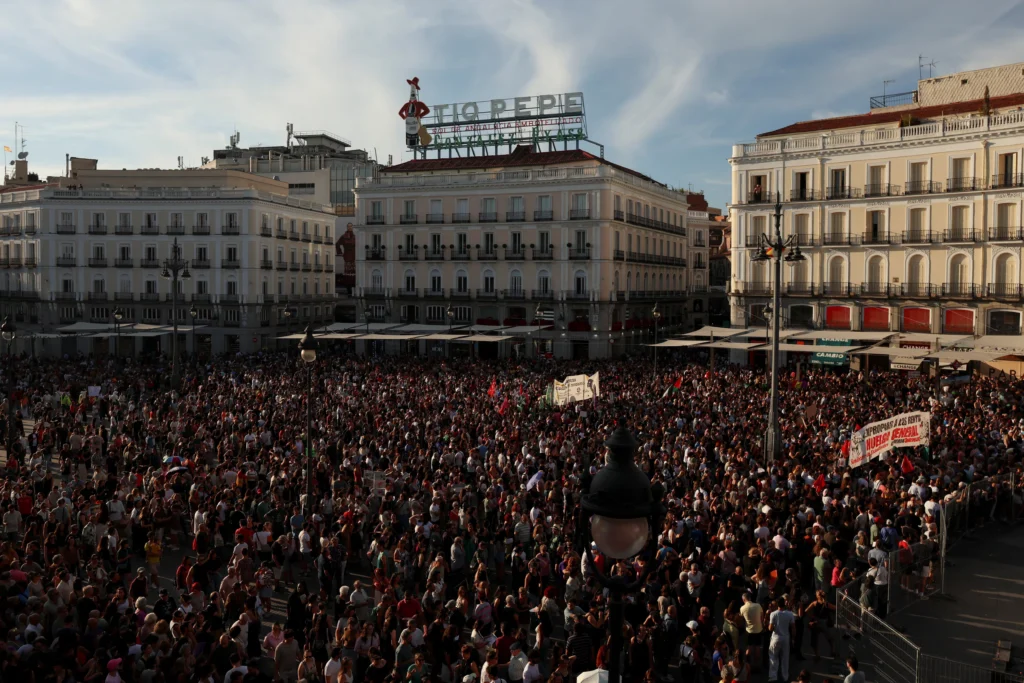
Five large actions in five weeks, called by Free Palestine Melbourne, have attracted tens of thousands of people – upwards of 30,000 or 50,000 for the last few weeks. The protests have grown over the five weeks – even though there has been little obvious publicity.
The latest action was the first to be filmed by a news helicopter, perhaps reflecting the movement’s growing momentum. It also follows from Foreign Minister Penny Wong’s new admission that the ALP now supports “steps towards a ceasefire”. The Biden administration too has been forced to soften its stance – at least rhetorically.
In Melbourne the large weekly rallies are only part of the picture of widespread organising. There are also daily, sometimes more than daily, actions targeting ALP offices, council meetings, local communities, train stations, government buildings, State Parliament, Universities, city streets, consulates, the Port of Melbourne, local parks – even the Melbourne Cup horse race.
New activist groups and networks have been established in specific councils, electorates, and unions, ethnic communities and religious, language or other groupings. Others have been set up to do specific tasks. For example, Free Palestine Printing supports the rallies with its printed Palestinian flags and signs.
Some of the Whatsapp co-ordination groups have hundreds of messages daily. Scores of people are ready to volunteer in an instant to help out how they can.

One example is that Melbourne activists organised at short notice to drive to Canberra for the November 13 protest at Parliament House. Leaving from multiple locations, many travelled from Melbourne to Canberra and then back to Melbourne in a single day.
The grassroots organising is being driven primarily by Middle Eastern and other migrant communities, including Turkish, and Lebanese – as well as the Palestinian community.
It seems the racism of the mass media, mainstream politics, and the general social outlook in Australia is, so far, still a barrier to immediate mobilisation of the broader community. Additionally, most Australians’ understanding of the “Israel-Palestine conflict” has been fed by decades of falsification of history, including in popular culture. However, the Middle Eastern community, or parts of it, feel the genocidal attacks on Palestinians as attacks on themselves, and are energetically fighting to put an end to it.
Still, Free Palestine Melbourne, has organised the actions along humanitarian lines. The principal demand on the ALP federal Australian government is to call for an immediate ceasefire. This focus has successfully drawn a broad crowd, who support such democratic, humanist perspectives.

What Strategy?
At the last two actions there has been little said from the platform indicating a clear strategic course for sustaining and growing this movement in way that can make it successful in forcing the Australian government to change policy. Only a clear change – in fact, a reversal – of Australian government policy will have any impact in Washington, and then Tel Aviv,
The overwhelming majority of speakers have used their time to concentrate on the moral culpability of the Israeli Government and their supporters in Australia and the US. This is often accompanied by advocating the need to grow the opposition campaign within Australia – without much discussion about how that can happen.
Margaret Beavis from the Medical Association for Prevention of War – one of eleven speakers at the November 12 action – outlined some of the Australia-Israel military ties. In doing so she also pointed to one category of very concrete demands the campaign can pursue. Military ties are also emphasised in some of the campus organising at RMIT and Melbourne University.
Sue Bolton, the Socialist Alliance councillor in Merri-Bek in Melbourne’s North, received one of the best crowd responses as she was able to report the recent victory of a local campaign. Merri-Bek council adopted a motion to raise Palestinian Flag for six months.
The detailed motion, among other things, also calls on the Australian government to
“End all military, economic, political and diplomatic ties with the state of Israel until it complies with its obligations under international law.”
Merri-bek council acknowledges,
“the current conflict did not begin on 7 October 2023 – it began with the Occupation of Palestine, and the forced displacement of millions of Palestinians from their homelands as a result.”
Israeli war crimes since October have, in rapid time, turned a growing section of public opinion against the Israeli state and spurned an energetic organised response.
Still, to force the Australian government to reverse policy (and in doing so contribute concretely to defeating Israel’s apartheid regime) requires some crucial steps forward. Essentially it needs to advance beyond the calls for protests that simply highlight and express our anger at the Australian state’s complicity and support for genocide and occupation. It must aim to END this complicity by forcing the Australian government to cut its military ties and diplomatic support for Israel and to fully recognise the Palestinian State.
Of course, the mobilisations do need to grow and diversify, and win over more of the Australian people, if the pressure is to be effective. This will require serious ongoing public education of the true history of the oppression of the Palestinian people which demystifies the Palestinian story. It will also need higher levels of organisation, including national coordination, in order to build the most effective campaigns. The work of the various Palestine solidarity and support groups has been fantastic. To the extent that we are able, we all need to help the campaign to be made even stronger and sharper.




Leave a Reply