
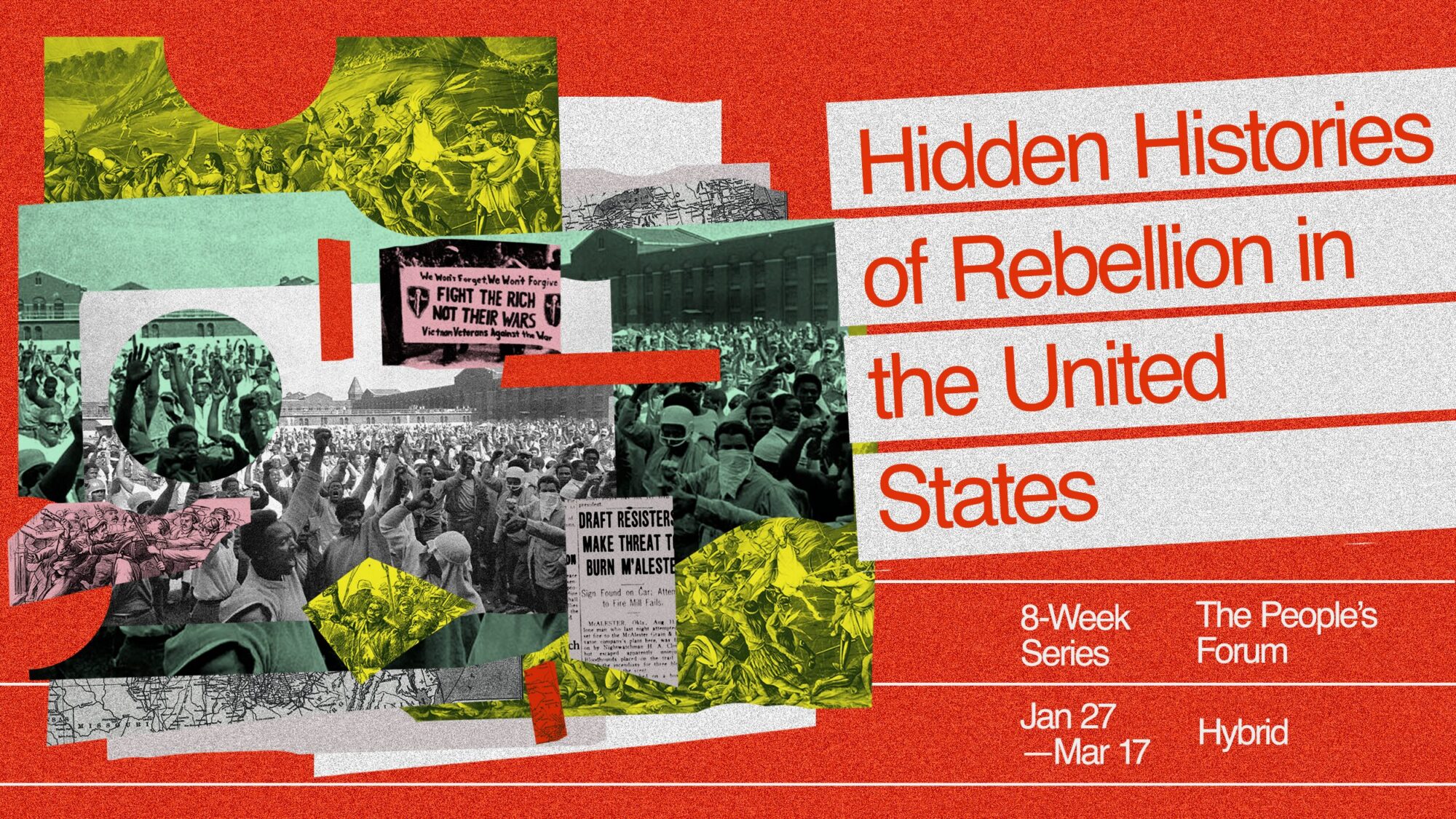
This lecture is the first of an eight-part seminar series hosted by The People’s Forum NYC, Hidden Histories of Rebellion in the United States.
Thank you Saidi, and it’s great to see everybody here. The number of people who are online, it’s really remarkable. There are thousands of people who have signed up for this eight-part course. I think the reason so many people have signed up is, it corresponds to what’s happening in society, where people are not just engaged in politics but very directly involved in politics – engaged in the battle for politics.
We saw in Minneapolis on January 23rd, the first general strike in a city in the United States since 1934. One hundred thousand people [came out] and the high temperature that day was 9 below zero. This was a real testament to the fact that, in spite of a very difficult climate, people were ready to mobilise and did mobilise – just an immense outpouring of people.
All the teachers went on strike, the schools were closed down. The Somali small businesses shut down. All of the unions came together. That’s very rare in the United States. It’s not rare in France. It’s not rare in Spain. It’s not rare in Colombia. It’s very rare in the United States, and it’s an indication that we are at a moment, a watershed moment, in fact, for the direction of the country – and people are coming together to organise.
Whenever people are active politically, when they’re involved directly, the thirst, the hunger for political education becomes very, very evident. Because when you’re just going about your business, your everyday life, you may be troubled about this or that, but when you’re in struggle, when you’re in motion, when you’re at the battlefield, so to speak, when you’re contesting with the police or with hostile media, or an administration that demonises you and describes you as domestic terrorists, and then engages in all kinds of violence – and you fight back, [you] don’t retreat, you’re not intimidated, you stay strong – all of the issues that you wouldn’t [normally] be considering, you start to, they become first, front and centre in your brain. That’s how people’s ideas change.
How Change Happens
And this course is about how people change and how change happens, how social change happens in the United States. Right now, there’s an effort by the Trump administration and the MAGA movement and Project 2025 to create a very vast change in society. They are very serious about what their plans are: the firing of hundreds of thousands of federal workers in the first days of the Trump administration; decimation of the environmental protection agency; decimation of the National Park Service, elimination of any remnant from the civil rights movement; [elimination of] the telling of history, full scale assault against trans people, trans kids, the LGBTQ community and immigrants who are being targeted and demonised.
This isn’t just random, weird, chaos created by a right-wing project. They have a plan. Project 2025 is the plan, and they intend to carry out a very significant change in the United States. And as a consequence of their very robust effort to carry out this change, they are meeting with the resistance of masses of people, and those people are determined to defeat MAGA. They’re determined to defeat Project 2025.
They’re now determined to defeat ICE, and we believe, firmly, that MAGA will fail, that ICE will be defeated, that the Trump agenda will be defeated, that this effort to, “Make America Great Again”, which means to take America back before the civil rights movement, before what we call the Civil Rights Revolution transformed America and really, in a way, carried out a cultural revolution, not just an economic or social, but also a cultural revolution in the United States… The effort by ICE and MAGA, and DOGE, and all of these other acronyms associated with the Trump White House, we believe this will fail.
In fact, we feel so confident that it will fail. That is a point of departure between our movement, which is a socialist movement, a Marxist movement, and many liberals who see what we see, who are anguished by what they see, rightfully, who are upset and outraged by the Trump administration’s program, but they basically, have been engaged in a lot of handwringing.
Like, “Everything is gone!”, “The country’s lost”, “What are we going to do?”, “Maybe we should move!”. It’s just this whole defeatist notion that because Trump is on a rampage that he will win. We think [that] not only misses the point, but actually undermines the capacity of the people to fight. If you feel you’ve already lost, people generally tend to seek individual salvation. Retreat, save yourself.
But if you feel it’s an unfought battle, in fact, if you feel that it’s a battle that can be won, and that everything you believe in is at stake, instead of running, instead of seeking individual salvation, you stand with other people and you fight. Truthfully, bravery is a social phenomenon. Bravery is not simply an individual act of courage by some especially courageous person. If I’m brave, you’re brave. If you’re brave, I’m brave. If we’re brave together, this feeling of struggle, this feeling of determination, this feeling that we can fight and win, this feeling that we refuse to surrender to racism or sexism or patriarchy, or all of the bigotry and discrimination and hatred. If we feel that way and act that way, we can win.
And if we don’t, we can lose.
So what we think and how we interpret the events is not something academic. It’s something that, I would say, is a life and death issue for our movement.
Events in Minneapolis
I’d like to bring up some photos of 3 individuals who have been murdered by ICE. First, it’s Keith Porter, killed at the end of the year in Los Angeles. Followed by Renee Goode, whose final words to the ICE agent who shot her three times in the face, were: “Dude, I’m not mad at you”. And then he shot her three times in the face.
Finally, of course, Alex Pretti. You see this slow motion shot, where he’s on his stomach, and the ICE agent takes his gun out. They shoot him in the back, and nine more shots are fired.
He’s executed. This wasn’t, like, a chaotic moment. Same with Renee Goode. A chaotic moment where in the fog of war, people make quick decisions.
No! This was cold blooded executions, intentionally carried out by ICE agents. In the case of Alex Pretti, they did that because they were upset about the general strike that happened the day before. They came out that morning, and they were gonna show people who’s boss. He wasn’t threatening anybody. He was filming them.
They came over to him, and the two women who were his friends. They pushed one of the women over. He steps in front and says, “Hey, don’t do that” and then they come at him, they swarm him. He has a registered gun, which is his right. They take the gun away, then they shoot him 10 times in the back. That was to send a message.
Frankly, if there had been no general strike the day before, if there had not been this mass mobilisation of the working class and young people in the Somali community, the very day before, the killing of Alex Pretti would have been [just] one more killing by an ICE agent. But instead, it sparked a nationwide opposition that’s all over the media, each and every one of you have been watching it, either on social media or mainstream media.
Trump Retreats
Then two days later, Donald Trump says, “Well, I’m reconsidering, I’m gonna bring Bovino”, the Gestapo-like, guy leading ICE in Minneapolis, “I’m going to bring him out”, “We’re gonna take some of the agents out”, “we have to reconsider what exactly happened”. It is like this superficial effort to sort of de-escalate. You know, to lower the temperature.
The reason Trump did that is the country is at a boiling point over what ICE is doing. I think everybody in this room knows it’s at a boiling point. People are seething with anger. Seething with anger. And if you think about the country as a boiling pot with a lid, there’s only three options: You lower the temperature, you take the lid off, or you let it explode. The country is a boiling pot right now because of the Trump administration’s aggressions on many fronts, ICE being one of them.
So Trump right now is trying to lower the temperature. And the Somali students, in particular, know exactly what Trump is doing, and they are asking all of us not to lower the temperature, but to turn the temperature up. They’re asking that the effort that they carried out in Minneapolis, to shut down Minneapolis, that we replicate that – not just in one city, but all over the United States, ICE out, nationwide shutdown, this Friday, January 30th.
We’re not looking to lower the temperature. We’re looking to get ICE out. We’re not trying to even get ICE out of Minneapolis. We want to abolish ICE. We want to abolish the entire instrument of repression.
There’s going to be an issue that’ll come up probably on Friday of whether or not ICE will be funded again. The Democrats funded it the last time around. There’s a lot of pressure right now growing in the country. If you say, I’m gonna call my congressperson and tell them, vote, no, that won’t mean that much. The only thing that will really stop this ICE war against the people is if the ruling class in America fears that the opposition to what ICE is doing will lead not only to resistance and rebellion, but possibly revolution.
That’s how the Civil Rights movement actually made the gains it did. It was the threat of revolution. It was the insurrection that was taking place in cities and towns, big and small, all over the United States, starting in 1955 and going up until 1972.
That’s when even Richard Nixon, the ultimate racist, who adopted the Republican Southern Strategy, he was the one who said, “let’s have affirmative action”. He was the one who created far reaching economic reforms, concessions to the civil rights movement.
It wasn’t a liberal Democrat, it was this racist, anti-communist Republican, Richard Nixon, because Nixon knew – as did the other ruling class politicians – that if they didn’t make serious concessions at that moment, the United States was going to erupt into civil war, and the government would be the target of a righteous indignation by the people, led by the Black community, but joined by Latino, Asian Americans, Native Americans, White people.
I mean, that’s what was actually happening in 1969 and ’70. Which brings me to the question that I started with:
How does change happen? That’s really the theme of our 8 part class. Our basic question (and I’m going to come back to why) is why will MAGA fail? Why will Trump fail? [The answer tells us] why we shouldn’t be involved in hand ringing, [why] we should be engaged in a fierce struggle to stop them – and if we do, we can win.
Lessons from the Civil Rights Movement
All right, let’s think about the civil rights movement and what it achieved. We call it a Civil Rights Revolution. It was still a capitalist system after the passage of the 1964 Civil Rights Act, and the next year, the 1965 Voting Rights Act. It wasn’t a revolution in the sense that it was a socialist revolution. But I just want to describe a little bit how things were at that time and how things changed.
In 1964, America was an apartheid state, a literal apartheid state. We’re talking about in my lifetime. We’re not talking about ancient history. I know I’m old, but I’m not that old. But I’m old enough that it was an apartheid state when I was a child. A literal apartheid state.
In Rochester, New York, where I grew up, Eastman Kodak was the company that ran the city. There were 250,000 people who lived in Rochester. 55,000 employees worked at Kodak. My father was one of them. He was a research chemist.
And of the 55,000 workers at Kodak, there were almost no black workers. I think there were about 70, out of 55,000, because Kodak was that racist. In 1964, in Rochester – 6 months before the rebellion in Harlem took place in that same year – there was an uprising in the Black community in Rochester.
Here’s the headlines, “Negro mob riots here”, “Homer declares state of emergency”, “The police came out, the youth fought back”. It went on for almost a week. It was the precursor to all the other rebellions: Harlem in 1964, the Watts Insurrection in 1965, Newark in 1967, Detroit in 1967, all over the country in fact.
Of course, when Martin Luther King was assassinated on April 4, 1968, that night, 120 cities went into insurrection, including Washington, D.C., the nation’s capital. And when I say insurrection, it was a state of complete rebellion. The U.S. Military was sent to 120 cities, probably more, that night.
During this time, when the rebellion happened in Rochester, this is somewhat of a personal anecdote, I guess, an organisation called Fight, F-I-G-H-T. Fight. I can’t remember what all the acronym stands for. I know the G is for God, and fight is for F is for fight. Right?
(laughter)
Anyway, you get the picture. FIGHT demanded that there would be 600 jobs set aside out of these 55,000 for unemployed black people in Rochester, New York, to which Eastman Kodak said, “No way, we will never allow you to tell us who we’re gonna hire and who we’re not going to hire. We won’t do it”. That initiated a protracted struggle in Rochester, New York, over whether Kodak would grant these 600 jobs. I mean, that’s not a big ask. That’s a pretty small ask. But they said no. It dragged out and became (you can research it at home), it became a nationwide symbol of the fight against capitalist corporate America and its racist discrimination policies.
Apartheid USA
The apartheid character of America wasn’t simply governmental laws, and it wasn’t simply in the South. Rochester is 30 miles as the crow flies from Toronto, Canada. It’s pretty north. The deep north you could call it … and they said “No”, and it became an epic battle.
My parents were involved in this because my parents were involved in the civil rights movement, so my father, as a chemist at Kodak, actually said, “I support the demand for 600 jobs.”. [That] basically ended his career.
We lived in this little suburb of Rochester called Irondequoit, which was one mile from the city and my parents had five kids. They decided they needed a bigger house. These suburbs opened up, and they were all white. Literally all white. As a matter of fact, they were sundown towns. They didn’t call them sundown towns, but they were sundown towns, meaning if you were black or a person of colour, and you were there after sundown, you were gonna get hurt, or you were gonna get killed. This was another form of apartheid in America.
So this little area, Irondequoit, New York, where we lived, was a sundown town, even though we didn’t know that word at the time. But there were no black people who lived there or were permitted. Nobody, no banker would give a black family a mortgage there. Again, this is not Alabama. It’s not Mississippi, it’s Rochester, New York.
When my father took a stand and supported the demand for the 600 jobs, he was completely -as was my mother -completely demonised by all of our neighbours. The entire neighbourhood stood with Kodak. Even though these were working-class white people, they were standing with Eastman Kodak and insisting that only Kodak should be allowed to make hiring decisions. If Kodak wanted to have an all-white workforce, that was their decision. That’s how it was in 1965 and 1964.
If you go back further, before the Voting Rights Act was passed in 1965, for instance, in Mississippi and in South Carolina, if you go back even to the year 1900, the African American population in Mississippi and in South Carolina was the majority. It wasn’t a black minority. It was a majority in Mississippi and in South Carolina. How many black voters voted in 1900 in Mississippi and South Carolina? That would be none. Or less than 0.5 percent because the apartheid system’s laws were enforced through terror, the terror of the police department and the terror of the KKK, and they weren’t distinctive organisations. The cops and the Klan weren’t just working hand in hand, as the chant went. They were the same – the same people. So were the judges. So were the bosses and so was the Chamber of Commerce.
America was so profoundly racist that in 1954, when the Brown vs. Board of Education Decision was taken. That was a decision by the Warren Court, making apartheid, separate, segregated schools no longer legal. It said there was no such thing as “separate but equal schools”, which is where Jim Crow was established in 1896. The Supreme Court in 1954 ruled that it’s not possible to be separate and equal, because the black schools were underfunded, to put it mildly. All of the resources in society were flowing to the white schools, and they said it’s against the law.
So what happened in response to the Brown v. Board of Education? There was the beginning of the academy movement, and the academy movement was vast number of white people in southern states taking kids out of public schools, even before the first black student was able to come into the public white school, and they created private academies. This is like the charter school movement. Where it really started was that the government then took public monies and gave it to private academies, who would use religious criteria and other false, BS metrics, to basically make sure they were all white.
The academy movement spread everywhere throughout the South. So even though the law of the country changed, meaning you now had to have desegregation, it was the same.
It was essentially the same. And that was a mass movement.
National Liberation Revolutions
Why did the Supreme Court finally, after two centuries, well, not quite 200 years, why did it finally decide to say apartheid was illegal in public schools? Because America had a problem. The problem was, after World War Two, China had a communist revolution.
North Korea had a revolution. Vietnam had a revolution. Indonesia was having a revolution.
India was having a revolution. The colonialised people of Asia, Africa, the Middle East were rising up in anti-colonial movements, and they were led by communist parties.
Ho Chi Minh in Vietnam, Kim Il Sung in North Korea, Mao Tse-tung in China. The US said, “Well, we’re fighting for freedom against these communists”. And the communists would say, “You have apartheid.”, “Where’s that freedom?”, “How can you have apartheid?”, “In the case of Mississippi, [you oppress] the majority of the population, and talk about democracy and freedom?”.
All the people in the so-called Third World, the Global South, when they heard, wait, the United States has apartheid against black people, and the Soviet Union, and China, and North Korea, and Vietnam are championing the causes of national liberation – it became a gravitational pull towards the communist movement.
The Warren Court decision in 1954 was the first effort by the American ruling class to overcome this major obstacle in the Cold War, which gave all of the advantage to the communists. They said, we have to start to reform and get rid of apartheid because it doesn’t conform to the new reality of a world that is becoming anti-colonial.
It was the international situation that actually motivated sectors of the U.S. Ruling class to make this reform. But other sectors of the ruling class thought this was terrible.
They weren’t thinking about how to compete with the communists in China, or Vietnam, or someplace else. They were [thinking] we want to control the Mississippi. We want to control Alabama. If you start to let the majority – meaning the black population – vote, we are gonna lose control. So we don’t care about China. We care about Mississippi.
You had a struggle between different sectors in the U.S. Capitalist ruling class. As a Marxist, it’s very important to understand that a class in society, whether it’s the working class, the proletarian, the petty bourgeoisie, the capitalists, whatever class you’re talking about – classes are not monoliths. It’s not like there’s one grand ruling class that all meets together and they have one thought pattern.
They’re not the ruling class because they all think the same thoughts. They’re the ruling class because they own the banks and corporations. But within that class, they can have different strategic views, different philosophies, etc. So, one section of the ruling class was trying to reform American capitalism away from this extreme racism, and other sectors of the ruling class were promoting what amounted to a mass white racist movement in America.
If you’re younger, if you think about the civil rights movement – ’50s and ’60s – you think Martin Luther King, Malcolm X, the Black Panther Party, Kwame Ture, Rosa Parks. That’s what we think about. But having been alive at that time and also politically active for the latter part of the 60s, the dominant force was not the civil rights movement. It was the white racist movement. People don’t know that. People think of the 60s as being like this panacea of leftism. You think of Woodstock and anti-war, and then Dr. King’s 1963 March.
There was a mass movement of white supremacy against the Civil Rights Revolution. And that movement, the white supremacist movement, was defeated.
And I’ll say a little bit about why it was defeated, but it was defeated. The MAGA movement is the resurrection of that old, defeated white supremacist movement. When they say Make America Great Again, they need to go back to the era where white supremacists had ruled the roost without dispute.
What they mean by that is not, just white working class people, if they’re reactionary. If they’re racist, they can be pawns in the game, but they’re not owning corporations.
They don’t have investments in the Middle East. They’re wedded to racist capitalists.
It’s a form of class collaboration.
So there was a war going on in the ’50s and ’60s. [Today] the Make America Great Again movement, is really an effort to go back and undo all of the social, economic, and especially cultural achievements that came about as a consequence of the Civil Rights Revolution.
Again, the fact that this kind of extreme racism greeted the beginning of civil rights reforms was not enough to stop it. Ultimately, because the movement succeeded on many fronts, (even though it’s still a capitalist system), because there were so many cultural, economic, and social changes in America, as a consequence of the Civil Rights Revolution, America has changed, and the right-wing sector of the bourgeoisie in America feels that they need to create a new form of governance to get rid of the social, economic, and cultural changes.
The 1964 Civil Rights Act made segregation illegal, and the 1965 Voting Rights Act made it impossible for the Southern states to create any voting laws in those states without the agreement of the Justice Department on the federal level. That meant that all of the tricks and patterns of racist disenfranchisement in Southern states was no longer allowed.
And there was a flourishing of black political representation in the South.
How did the Civil Rights Movement Achieve Changes?
I would say those two bills, the 1964 Voting Rights Act and the 65 Voting Rights Act, are by far the biggest, most important, most far-reaching pieces of legislation in American history. How did it happen?
If you look at the U.S. Congress in 1964, that passed these two far-reaching bills. From a point of view of demographic composition, it’s exactly the same as Congress in 1954, when it upheld apartheid. There were very few black representatives. The Congress was dominated by the Dixiecrats – the Southern Bloc. It’s the same Congress.
So how did this Congress that was so reactionary and racist in 1954 have the most far-reaching legislation in American history one decade later? Well, they didn’t change. People changed. The masses of people, by the millions, changed because they became political actors. The civil rights movement was the activation of tens of millions of “ordinary people” who became political.
When we look at Minneapolis, what just happened on January 23rd, that was not 100,000 socialists. I mean, maybe in a year or two, they’ll be socialists. If all goes well – if they’re watching our classes.
(laughter)
But no, that’s not what motivated them. What motivated them was the brutality of ICE.
The terrible right-wing assault by the Trump administration. And when people get involved in the struggle, like take Alex Pretti, who was assassinated. He’s an intensive care unit nurse at a VA hospital. He was leading his life. He was doing good deeds.
He was obviously a conscientious and beloved medical professional, but he wasn’t going out Saturday mornings with his cell phone to, you know, film ICE agents or police agents.
He was one of those 100s of 1000s of Americans around the country who have been brought into politics right now.
And what brought them into politics? It wasn’t only Trump, and it wasn’t only Project 2025. It wasn’t only the assault on our basic Democratic rights in the United States. It was also what happened starting on October 8, 2023 – Palestine. How many millions of young people, in particular, many who are probably in this room, came to demonstrations not once, not twice, not once a year, not a conference once in a while, but all the time?
They were witnessing a genocide in real time on their smartphones. [For] the first time, people who weren’t at the battlefront or at the scene of a genocide – we watched it.
And we also knew that the government, that speaks in our name, was lying. The government that sends our tax dollars to fund the genocide was lying. [We know] that all of their arguments – like in the early days – remember when a hospital was blown up, and the Israelis said: “Well, that was a Hamas rocket that misfired and it landed on the hospital.” Then there was two weeks of debate in the New York Times, on MSNBC, in Fox News, like, “Who destroyed the hospital?”
Well, a year later, all the hospitals were destroyed. There’s no question about why they’re destroyed. The Israelis destroyed them. Every university was destroyed because the Israelis blew them up. If people had just been at home watching, they might have been mortified, they might have been upset, they might have wanted to change the channel because it’s so disturbing.
But if you’re in the streets, if you’re organising, if you’re with your fellow students or coworkers, or people in your community, or your family – and you’re in the streets, and you’re out there every day, when it’s cold, or when it’s raining, no matter what, you’re there with the Palestinians – and then you see how the lies are being presented by the capitalist media, you realise that the problem, the problem here isn’t a bad policy. The problem isn’t a mistaken policy. The problem isn’t a bad politician or a mistaken politician. The problem really is a system. And then you think, “Well, what is this system?”, “Does it have a name?”.
If you ask school kids, what’s the name of the U.S. System? They might say democracy or republic. Nobody in the past would have said, oh, we live in the capitalist system, and all the problems that we’re facing or seen are the problems of capitalism. But when you’re in struggle, and this, this phenomenon, this process is taking place, and you’re looking for answers in your thinking and seeing for yourself, it’s not a mistaken foreign policy, a mistaken lead, or a bad party, as opposed to a good party. When you realise it’s a system, then you want to know what this system is.
Who benefits from it? Who profits from it? What’s it called? How did it evolve? How did it get here? And you also think, “Can we have a different system?”.
I mean, the kings and queens of medieval Europe told the serfs, “This is how God wanted it”. “You’re a serf, and I’m a noble because this is God’s will.”. A lot of serfs believed that, because they were devout religious folks who went to church and the clergy – who was the 2nd estate, along with the nobility – told them” yeah, this is exactly what God wants.” “This is exactly… you do all the work, we pray, and all the money goes to the church and to the king.”
Then, finally, there’s a revolutionary process, and people realise, “Well, no, this is not what God wants. This is a system that benefits a ruling class, and we can have a new system.”
And once you have a new system, you don’t normally want to go back to the old system.
There’s not a yearning in Europe right now, in spite of how messed up Europe’s politics is, nobody’s thinking like, can’t we have an absolute monarch? There’s not some beck and call for a return to medievalism. In fact, if somebody said, “yeah, let’s have the farm workers be serfs.”, they would be, they would be destroyed. It would be completely impossible.
MAGA wants to go back to the old system before the Civil Rights Revolution and say, “Let’s go back.” People don’t want to go back. Some people may want to go back. I mean, what is MAGA really, and what is Project 2025? It’s a coalition of two things. There’s two wings to this:
The MAGA – Make America Great Again – is really a vessel, really just for Donald Trump.
And Trump was this seemingly anomalous, weird, reactionary reality TV guy.
Uh, very different from all other politicians, catering to sort of anti-immigrant, racist notions, especially in the white population and especially the rural white population. The electoral system is constructed that gives a great advantage to rural and small towns in America – even though 87 percent of the people in the country live in urban areas, which are generally not aligned politically and ideologically, and culturally with what MAGA stands for.
So MAGA, in one sense, is a vessel for Trump, who became a popular politician with what part of the population? Maybe 30 percent? Not really more. It’s probably 30 percent.
Project 2025 is something different. Project 2025’s author is Russell Vought.
Russell Vought is a long-time, semi… I don’t know, when do you call somebody a fascist or a semi-fascist? I mean, it’s a judgment call. But Vought believes that the problem in America was the Civil Rights Revolution because the Civil Rights Revolution detonated other movements: the women’s rights movement, what was at that time called the gay liberation movement, the movement that allowed disabled people to have access to things, the environmental protection movement that inhibited what corporations could do, that regulated and told corporations, they couldn’t completely poison the air and water, the lakes and rivers and air, at their own discretion, that there had to be some government oversight. That came also from the Civil Rights Revolution.
Russell Vought believes that the Democratic Party and the sector of the ruling class that’s aligned with the Democratic Party accommodated themselves to the Civil Rights Revolution changes because they are communists. He believes the Democratic Party leadership is communist. What does that make us, then? They actually believe it.
When you read Russell Vought’s stuff, he [says] these people are communists, and the reason he knows they’re communists is that they supported civil rights. Now, they didn’t really support civil rights, but the Democratic Party acclimated itself to the demands of the civil rights movement when they became institutionalised.
I have this quote [that Andrea Lucas], head of the Equal Employment Opportunity Commission, just made an announcement that she’s urging all white male employees who feel that they have been the victims of racism and discrimination to come forward and file a claim with the EEOC.
[That is] an agency designed for and created by the civil rights movement, to remedy past discrimination, like what I was showing you about Eastman Kodak, where black people could not get jobs. I also worked at Bausch and Lomb in Rochester, which makes eyeglass lenses.
In 1965, there were 8,000 workers [and] zero African American workers. And now the EEOC head leader, Andrea Lucas, is saying, “White men, please come forward and file your claims because we know the real problem in society is that white men have been discriminated against.”.
When you look at the history of the country, on all fronts, and come to the conclusion, it’s so obviously sort of an appeal to a section of the white population to mobilise them on the basis that whatever problem they are encountering, it’s a consequence of the Civil Rights Revolution.
Russell Vought and the MAGA leadership, they want to take that part of the white population, galvanise them into a little reactionary, racist army, in order to reverse the social and economic and cultural changes that not only were good for society and good for people, but that inhibited capitalism. You know, those demands that you had to build an access ramp for disabled people, you couldn’t simply pollute the rivers at will, you couldn’t poison the air at will, the Occupational Safety and Health Act. Capitalists have to give workers basic job safety.
When I worked at Bausch and Lomb, which was in the early 1970s, the temperature there was 125 degrees in the unit. We were using chemicals which were later banned under [Occupational Safety and Health Administration] OSHA. Every week, some worker would have some disgusting, terrible, chemical burn, third-degree burns. There [was] no safety regulations.
That’s what Project 2025 wants to go back to – this unfettered rule by capitalism. But they couldn’t do it, they couldn’t get the job done unless they had a popular mass movement. So MAGA is the popular mass movement, because Trump was popular with a certain part of the population.
All the work behind the scenes at the Federalist Society, or [American Legislative Exchange Council] ALEC, or these different agencies and institutions to rewrite the laws against the Civil Rights Revolution, and all the women’s movement, and the social justice movements, and the environmental movement. They were not succeeding, but with Trump, they had a man on horseback. They had what is needed for a right-wing counter-revolution: mass base. These policies are so unpopular that MAGA felt we can [only] do it with a mass base, but the mass base is only 30% of the country.
So that’s the question, everybody. If they have 30 percent of the population, and 70 percent don’t agree with them – and yet, 70 percent don’t do anything, or the 70% are waiting for November 2026 for a midterm election so they can vote for some Democrats who will immediately compromise with Trump. If that’s the idea – if that’s the thought process – we lose, and MAGA wins.
But we feel that MAGA won’t win because that’s not what’s going to happen, and we think Minneapolis is a testament to that. Minneapolis is where George Floyd was killed May 25th, 2020. That was the first Trump regime year. Trump tried to use the military against the masses of people in Minneapolis and around the country, including Washington, DC. By May 30th, all the Democratic governors and the mayors, including the mayor of Washington, were going along with the curfews and the suppression.
Remember, [on June 1] Trump walked across Lafayette Park to have his picture taken with that Bible in front of St. John’s Church, and in order to get there, they had the police just pepper spray and hit all these people who are peaceful protesters with less than lethal munitions, which still cut up your body or destroy your eyes or whatever. He walked through, and he held his Bible there in front of St. John’s. That was the day he had a conference call with every governor saying, “You either crack down, or we’re sending the army.”.
He wanted to send the army then, just the way he’s sending the military now. And what happened the next day? The next day, instead of the governors and the mayors being able to go along with him, tens of millions of people came into the streets all over the country. That’s what happens if we remember June 1st, June 2nd, June 3rd, 2020. That went on for six weeks, and it changed the whole narrative.
Even the NFL and Major League Baseball were [saying] “Let’s take a knee.” Like, really? These billionaires, [were saying] “Yeah, let’s take a knee. Yeah, and the Confederate statue, that has to come down. We hate that. It’s been there for 100 years, and we loved it last year, but now we hate it. We really hate it, and it doesn’t stand for what we believe in.”
The whole narrative shifted for a moment, but it was just a moment because everything then kind of got sidetracked into, “Well, who are you going to vote for – Biden or Trump?” So all of the energy from the street, which was so dynamic, it was 35 million people in the street. Everybody said, “Let’s really make a difference by electing Biden so we don’t have a second Trump administration.”
All of the energy got funneled into the Democratic Party and into the election of Biden.
And what did Biden do? He reversed all the COVID aid programs. You know, the COVID aid program, which came under Trump and then Biden: You got $300 a month per child, every family. That brought childhood poverty in America down 50 percent in one year. Biden ended the program.
It shows that childhood poverty is a policy choice, right? They decided to spend the money on something else, not on that program. If you can eliminate childhood poverty by half, in one year, it shows it’s a completely remediable problem. So it’s a policy choice.
So, our movement went with the Democrats because that’s the game. The game is: “You hate the Republicans enough, you hate [Trump] enough. We gotta get him out of there.”
And who’s gonna take his place? Well, it’s gonna be a Democrat, because the system is rigged so that only one of the two ruling class parties has a chance of winning.
I’m with the Party for Socialism and Liberation. [PSL Presidential candidate] Claudia de la Cruz and [Vice Presidential candidate] Karina Garcia ran a great campaign, promoted socialism, got a huge number of votes, but they’re excluded from the TV debates.
They don’t have $3 billion for TV ads. In many of the places we got on the ballot, the Democrats then spent $100 million to get us off the ballot, and we were a minor party.
But they spent an enormous amount of money in Georgia, Pennsylvania, Ohio. The system is rigged.
So if you really want change – which we all do – it’s understandable why people would want to vote Trump out and the Republicans out. Understandable. Got it. But that’s not where change comes from, because then what happens is that the Democrats, essentially, because they are a ruling class party, either compromise with the far right, or go even further in some way. In the case of war and peace, the Democrats, I would say, are even worse.
If we think back to what I said a few minutes ago, where does change come from? It’s not the politicians – not changing the politicians. That Congress, in 1964, was the same Congress as 1954. Yet, the same Congress passed the most far-reaching legislation in American history, the Civil Rights Act, and the Voting Rights Act, not because they changed. We changed – meaning we became political. We became active. Our communities became active.
The people, once organised, become an irresistible force. There are two kinds of change that can take place: far-reaching economic reform or revolution.
Now, there have been two revolutions in the United States, well, two and a half. The American Revolution was a political revolution. But at the end of that war, the slave owners were still the slave owners, the enslaved people were still the enslaved people. The social fabric of society was not altered. It was just that the ruling class colonists became independent from the British ruling class. Doesn’t mean it wasn’t unimportant, but that’s what it was.
The U.S. Civil War was more of a real revolution because the system of enslavement – [where] enslaved people constituted the centre of the American proletariat – that system ended, and it hasn’t come back yet. I don’t mean it’s coming back.
In fact, it kind of came back, five years later, ten years later, with the defeat of Reconstruction, the bloody counter-revolution in the South, when Northern capitalists betrayed the struggle for equality and freedom, by cooperating with – rather than fighting against – the old, defeated slaveocracy.
And then this defeated slaveocracy told the story of the Civil War from their point of view.
In New York City, right up until the 1930s, the Civil War was taught from the point of view of the Southern defeated slave owners. It was only the teachers’ union in New York that insisted that the war be taught to New York City public students from the vantage point of the North.
That was because the teachers’ union was led by communists at that time. They insisted that the North teach the Northern version of the Civil War. So in a way, the South won the Civil War, even though the system of slavery, which had been the centrepiece of labour in the South, was formally and technically and legally ended (unless you’re incarcerated, in which case, the Constitution says, you are enslaved, you can be enslaved.).
So how does change happen? It’s not gonna be by supporting the Democrats. It’s not gonna be by supporting the lesser evil. The problem really is the system. The ruling class has different factions and tendencies. If our movement says, “Look, one section of the ruling class is really bad. So we’re gonna follow and be tied to another section of the ruling class.”, then the idea of system change goes away.
If you believe that the real problem is the system and that society could be reorganised, such, for instance, that a new Constitution would say, “Bill of Rights, number one: free healthcare for every person in the United States. Every person who lives here, not just citizens. Number two: free education up to and through secondary education. Absolutely free. Third: housing must be affordable, no one can take your home from you, and housing can never be, say, more than 6% of your income, or free. Four: that you are guaranteed employment at a good salary, or if you can’t work, that you’re entitled to a basic income that can never be taken from you.”
These are the first four rights. The only rights that we have in our Bill of Rights are our inhibitions on what the government can’t do. It can’t inhibit our free speech. So homeless people have a right to speak, but they don’t have a right to a home, right? If you’ve gone bankrupt because you can’t pay your doctor’s bill, you have a right to speak about that, but you don’t have the right to go to a doctor for free.
So instead of having a bill of rights that are simply inhibitions or prohibitions about what the government can’t do on the political level, a Socialist Bill of Rights would be what society guarantees to every person. I was in Cuba recently. Cuba is suffering. Cuba is really suffering because of the blockade. I mean, in the 60s and early 70s by Caribbean standards, Cuba was affluent. [its] healthcare system second to none. Life expectancy [is] still the same as the United States, in spite of the blockade. But they can’t buy anything. They can’t sell anything. [The country] can’t trade. They can’t do any of that. There’s blackouts every day; it’s terrible.
Article 5 of the Cuban Constitution says the state has an obligation to provide free healthcare services to all of the people who are on the island of Cuba for their entire lifetime, from the time they’re born till the time they die. Here’s a country that’s so poor because of the blockade, and yet they make a legal guarantee to their people that healthcare is a right, not a privilege. If Cuba can do that under these circumstances, just think of what the United States can do.
Zoran Mandani’s election was a stupendous blow against the MAGA narrative about how right-wing the country is going to be. His demands are positive and progressive, like free buses. That’s great. They should be free. So should subways. So should healthcare.
So should the things that I just talked about.
The way to do it is we have to build an independent people’s movement that has – I believe – socialist understanding, socialist values, socialist and perspective, perspective about how change happens, that people make change. When we change, because we become politically active and [are] struggling, then change happens – whether it’s far-reaching reforms like the civil rights movement or environmental protection, or even more profound change of revolution. It’s when we change, when the people change.
And so that’s when we go out and demonstrate, when we leaflet, when we do all the things that we’re doing. We’re not trying to impress Donald Trump or Chuck Schumer. We’re trying to reach out to the people in the working class – the young people, especially. The people who are the agents have changed. Because if they become involved, as we’re involved, we can make the change that we want.
Brian Becker is a founding member of the Central Committee of the Party for Socialism and Liberation, the National Director of ANSWER Coalition, and host of The Socialist Program.
Transcript edited by Red Spark Australia: Luciana Yeda, Sam King and Jack Lavers.


Leave a Reply