
Desperate Measures, Art, Politics and Performance in Freo 1977-1985. Walyalup-Fremantle Arts Centre.
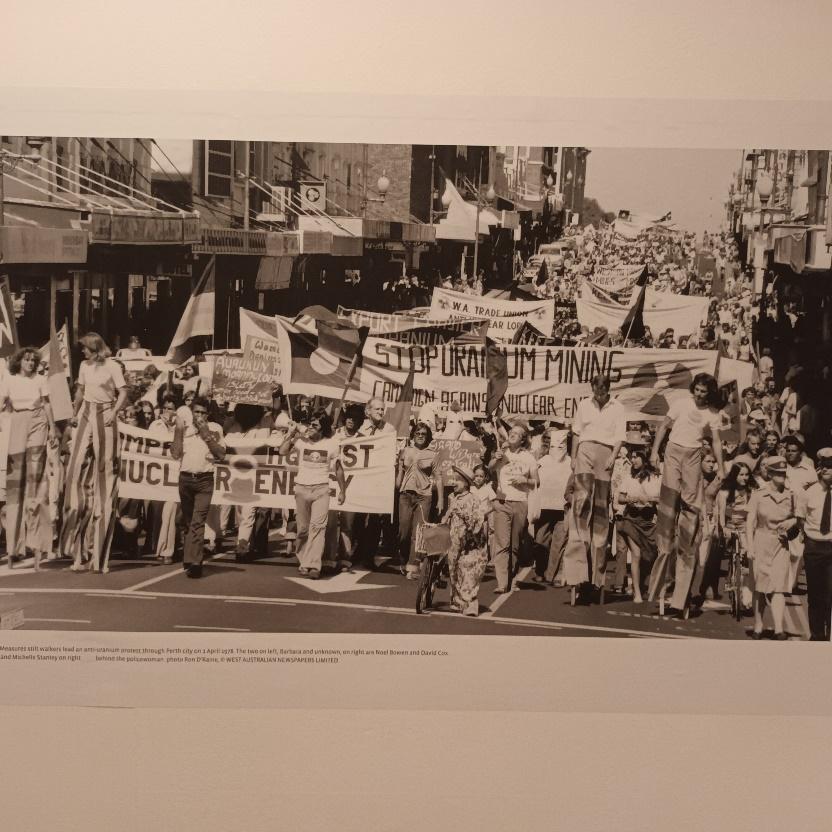
Anti-uranium mining protest, Perth, April 1978
Perth, Western Australia claims the distinction of being the most isolated city in the world. Perched precariously on the continental fringe it could be expected to also be the most boring city in the world.
However, in Perth from the early 1970s to the 1980s a coincidence of both reactionary and progressive elements mixed with international and purely local factors to force-feed a wave of protest and artistry. Desperate Measures is a collection of memorabilia of that creative era.
Desperate Measures could not have come at a better time. Many of the issues that animated that wave of protest are again with us in the form of the AUKUS submarine deal.
If Perth is somewhat self-consciously isolated, then its port city of Fremantle is even more so. Dotted with mansions from its late 1890s to early 1900s boom, by the 1960s it had settled into being a hard-drinking, working class, brawling and distinctly down-market suburb. It wore its history of fierce union battles with police and scabs on its sleeve and always returned a Labor member of parliament.
Facing off against it was the government of premier Charles Court, which hated everything about Fremantle.
Court had aspirations to run the state on the same corrupt and dictatorial lines that Joh Bjelke Petersen had been doing in Queensland. His arch-conservativism ranged from attempting to ban public political gatherings of more than three people (which resulted in a national strike of unions in 1979) to organising a scab convoy of trucks in an attempt to destroy Aboriginal land rights in the Noonkanbah dispute.
His reactionary and repressive agenda produced a steady stream of protest.
An exhibit in Desperate Measures is a 1980 report from the West Australian newspaper of a speech Court made to graduating police recruits. He said that the most dangerous enemy they would face was political and social activists!

West Australian newspaper March 29, 1980 report of premier Charles Court telling graduating police recruits that “evil” social and political activists were the greatest danger they would face.
The foundation of Murdoch University in 1973 brought a new edge to Fremantle. Murdoch in its early years was notable for its avant-garde teaching techniques and politically engaged subject matters. Murdoch students rented the ramshackle mansions cheaply, packed them tightly and held famously wild parties.
The concentration of youth nestled in a milieu of tough unions facing a reactionary government, just needed a unifying theme to bring out its creative and defiant voices. The inclusion of Fremantle as a side-show in the manoeuvres of US imperialism in West Asia was that spark.
When US Navy flotillas started patrolling the Persian Gulf in an attempt the strangle the Iranian revolution the Australian government, with the WA government’s enthusiastic support, agreed to Fremantle being uses as a US R&R port.
The scale of these visits was astonishing. For example, when the nuclear-powered and armed USS Carl Vinson came to port with its 13 support vessels it brought 200 nuclear weapons and 10,000 sailors and Marines who flooded the streets and nightclubs. In a city with a population of less than a million they intruded into every aspect of life. Everyone experienced US imperialism right in their faces and people took sides.
The Liberal government warmly embraced the ships, even setting up a special, widely advertised dial-a-sailor phone line so young Perth women could provide warmer embraces.
Solidarity activists with the Sandinista revolution in Nicaragua took to the streets with leaflets aimed specifically at the US personnel urging them to not die in Washington’s wars. In Fremantle the Project Iceberg group invaded the US ships to unfurl banners on deck.

Project Iceberg protest on board the USN Worden, Freemantle Port, July 1983
The Women for Survival and the Women’s Action for Nuclear Disarmament organised a two-week-long women’s peace camp outside the gates of the HMAS Stirling naval base at Garden Island, just south of Fremantle.

How the West Australian newspaper reported the women’s peace camp at HMAS Stirling naval base.
These years of activities had associated guerilla theatre troupes, campaigning artists and bands playing protest songs.
Walking into Desperate Measures the viewer is greeted by a massive version of Beth Hewton’s All Smart Girls Say NO! NO! NO! No Sailors, No ships, No bases, which circulated in the era as a postcard. It bitingly satirises all the aspects of the conservative agenda, especially its sexism.

All Smart Girls Say NO! NO! NO! by Beth Hewton
Below it is a series of t-shirts produced at the time with slogans such as No Home Port for Nuclear Ships, Shove Off Sailors and I Hate the Police.

I Hate the Police t-shirt

No Home Port for Nuclear Ships t-shirt
Documentary and dramatic films made during the protest period are shown as the viewer wanders through the galleries. There is film of radical feminist band, Tokyo Rose playing in a pub during their tour of northern WA, performing their song It’s Hard to be a Dyke in Hedland.
The pub audience is entirely drunken male workers from the mining industry. To put it mildly, Tokyo Rose had guts!
Also on show is the film The Pursuit of Happiness by Martha Ansara. It is a dramatised representation which is virtually a documentary of the whole Fremantle art/protest scene. It has shots of anti-nuclear campaign organiser (and subsequent Nuclear Disarmament Party Senator) Jo Vallentine on the docks, megaphone in hand addressing protesters (including me).

WA police on Fremantle wharf, protecting US warships. From the film The Pursuit of Happiness by Martha Ansara

Prominent peace campaigner, Jo Vallentine speaking while protesters swarmed the dock where US warships were tied up. From The Pursuit of Happiness by Martha Ansara.
One exhibit is a photo of the minutes of the motion passed at a 1980 meeting of Fremantle Council declaring the city a nuclear-free zone. Fremantle was the first council to do that and sparked a nation-wide movement.

Seeing the names of the Councillors who voted for it gives a measure of how far Australian politics has come. One of those voting for it was Peter Newman who is today a leading figure in the Inter-governmental Panel on Climate Change. Another was Norm Marlborough, the then president of the Fremantle ALP branch. It is inconceivable today that any ALP representative would be allowed to vote in opposition to AUKUS.
Another exhibit of a crowd of smiling protesters includes Jane Hammond, who is still making environmental documentaries in WA.
The cumulative effect of all this protest was to force the government to stop the R&R visits. Desperate Measures shows the high-water mark of the protest tide, but that tide needs to return.
Under the war-mongering AUKUS agreement the HMAS Stirling naval base at Garden Island is now hosting visits by nuclear submarines. Radioactive waste is intended to be off loaded at the base. Local councils are being lobbied by military industries to welcome the new war facilities as job creators.
Thousands of US personnel are slated to be housed in the suburbs around Rockingham. The area appears to be headed in the same direction as Okinawa and other places that have US bases inflicted upon them.
With Peter Dutton’s counterposing of nuclear power plants to sustainable energy production and the overall context of war with China the era of Desperate Measures is with us again.

Leave a Reply