
The 2020 supply chain collapse and the digital economy
In 2020, global supply chains seized up. Container ships waited offshore for weeks, factories closed, and world trade plunged. Yet once initial lockdowns passed, government-stimulated consumer demand for manufactured goods surged. The demand was there, but the capacity to move physical goods was entirely missing.
Ports ran short of workers, truck drivers were scarce, and empty containers piled up in the wrong places. A system long celebrated as frictionless, flexible, and immaterial suddenly ran headfirst into physical bottlenecks of workers, warehouses, and ships.

This crisis exposed a truth that the language of digital capitalism encourages us to forget: capitalism still rests on the material organisation of production. Factories, ports and mines have not disappeared; digital capitalism fundamentally depends upon them. The development of this digital economy is not an escape hatch from capitalism’s physical contradictions. At precisely the moment digitisation was presented as evidence that we had moved beyond the industrial world, the pandemic proved that the assembly line had actually spread.
Fordism, Taylorism and the algorithm
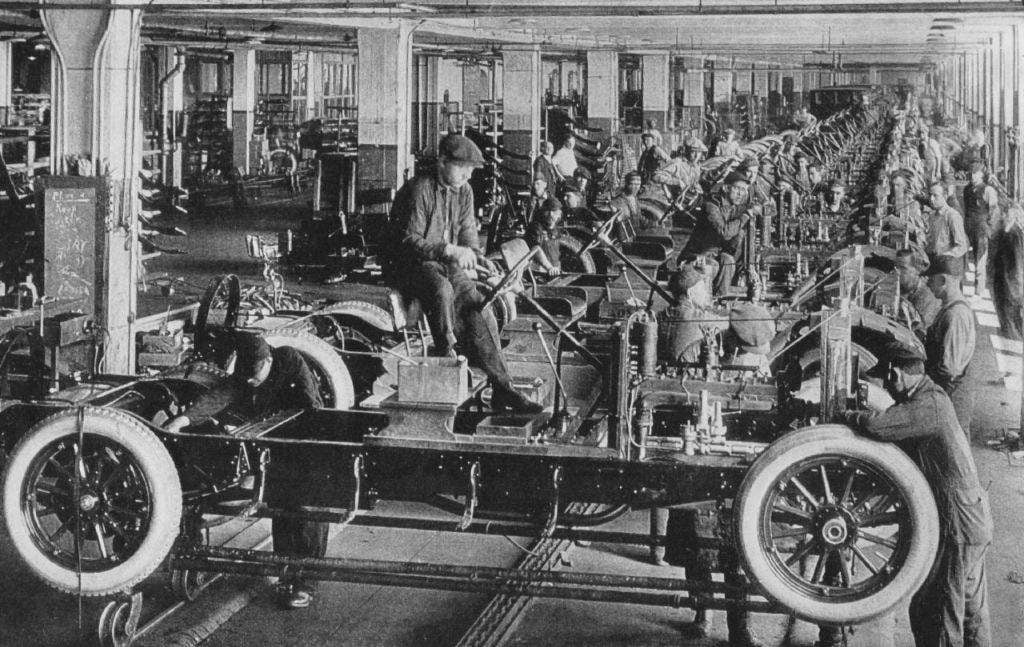
To understand why, we must look to Henry Ford. When he introduced the continuous moving assembly line in 1913, he reduced Model T production time from twelve hours to ninety-three minutes. The belt brought work to the worker, embedding the rhythm of production into the layout of the workplace. As Karl Marx anticipated in the Grundrisse, machinery reshaped the means of labour into a form adequate to capital.

While Fordism handles the mechanised, sequential flow of production, Taylorism governs the measurement of labour itself. Frederick Winslow Taylor broke work down into standardised, measurable movements to eliminate “wasted” time. The assembly line established the workflow; Taylorism established the speed expected from the human operator.
This distinction is crucial for understanding digital capitalism. Digitisation is not simply another wave of automation; it is a much more powerful instrument for monitoring, measuring and controlling labour. Taylor’s stopwatch has become an algorithm.
The assembly line has become software
Post-Fordist theorists in the late 20th century argued that the traditional factory system was giving way to distributed, just-in-time networks where information mattered more than physical production. However, while the geographical and legal forms of corporations changed through outsourcing, the core logic of the factory persists.
Step into a semiconductor fabrication plant, an Amazon fulfilment warehouse or a food-processing facility: production remains divided into discrete, sequential operations coordinated around a continuous flow. The assembly line has not disappeared; it has been generalised across the entire economy and increasingly takes the form of software.
An Uber driver or a subcontracted delivery courier does not stand beside a physical conveyor belt. Rather, their activity is bound to a digital system that dictates their routes and enforces performance targets, applying continuous pressure to keep moving. Under capitalism, digitisation functions through three distinct mechanisms:
- Automation: Breaking professional and clerical work into components to save labour costs.
- Deskilling: Minimising the value of specialised worker knowledge by steering complex decision-making through software.
- Control: Utilising algorithms to continuously monitor thousands of workers, automating supervision to maximise the production of value by labour.

What capital celebrates as “flexibility” is experienced by labour as legal and physical fragmentation. Legal separation via subcontracting or independent contracting does not change the industrial reality of production; it merely distances the corporation from the workforce while redistributing risks downward. Digitisation does not create a new mode of production; it reorganises the balance of class power within the existing one.
The political question: organising the chain
This reality highlights the central contradiction of technological development. A machine that allows society to produce more with less labour should theoretically provide shorter working hours, less drudgery and greater human freedom. Under capitalist social relations, however, technology is instead used to sack some workers while intensifying the exploitation of those who remain.

The technology itself does not determine this outcome; the social relations governing its use and development do. Therefore, the critical question is whether workers can effectively organise within the fragmented structures that capital has built.
While algorithmic management individualises pressure and subcontracting breaks workforces into separate legal entities, the physical system remains deeply interconnected. Just-in-time logistical systems are highly vulnerable to disruption at critical links that, in logistics jargon, are called “single points of failure”. A small group of workers at a strategic port, warehouse, or distribution centre holds power far greater than their numbers suggest because they sit at the vital intersections of production and circulation.
Organising can no longer stop at the boundaries of individual workplaces. It must span across subcontracting chains and logistics networks to confront systems that disguise labour discipline as neutral technological progress. Within the world of digital capitalism, the assembly line is still with us, and so is the class struggle taking place along with it.




Leave a Reply