
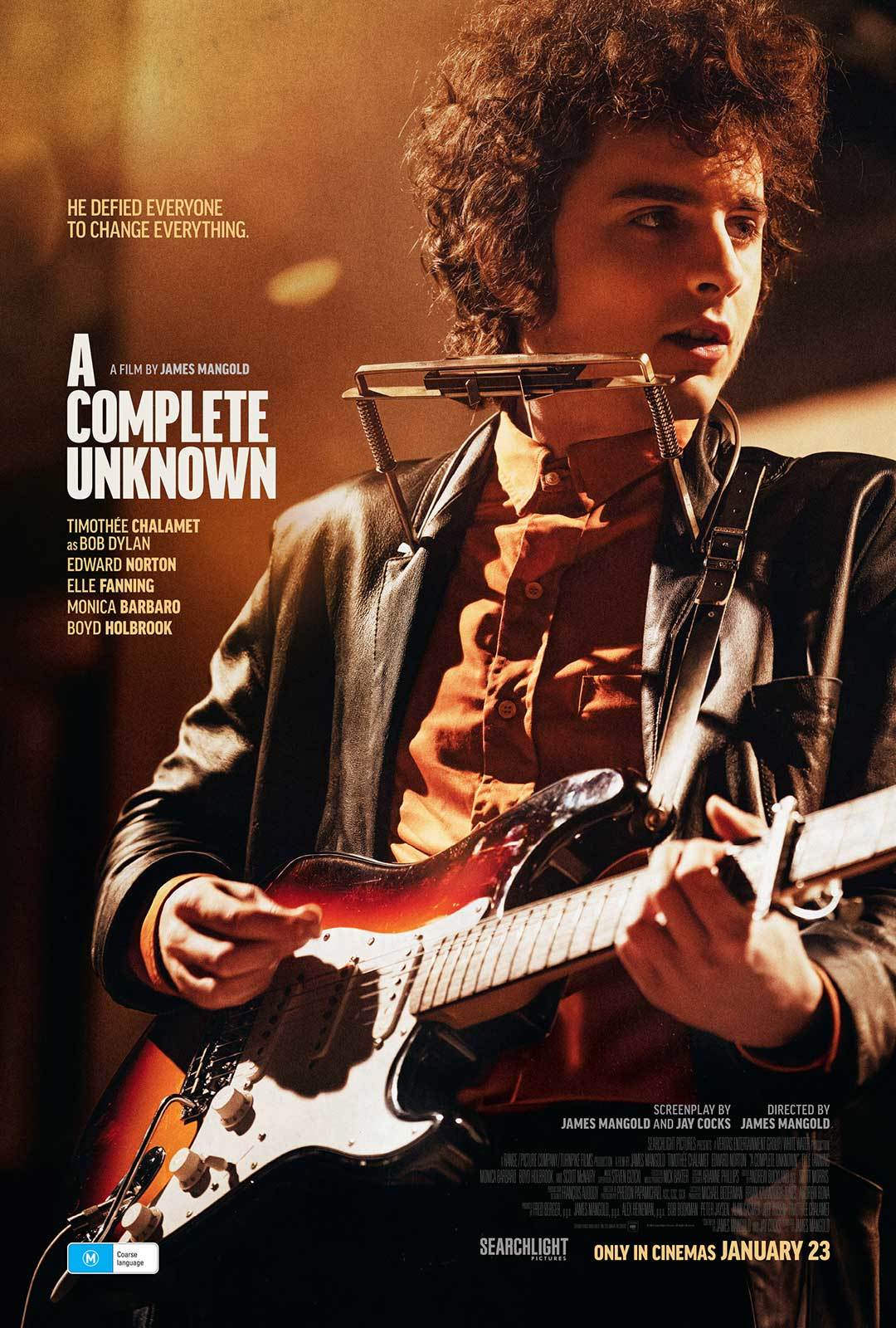
A Complete Unknown
Directed by James Mangold. Starring Timothée Chalamet, Edward Norton, Monica Barbaro, Elle Fanning
A Complete Unknown begins in 1961 with a guitar-toting, nineteen-year-old arriving in New York and shuffling his way down Manhattan to Greenwich Village. Within two years he has achieved international stardom, recognised as the spokesperson for his generation by singing protest anthems like Blowin’ in the Wind.
Any film dealing with this time and place and the cultural phenomenon that is Bob Dylan has to make certain choices. Perhaps it can concentrate on the vibrant political context which propelled him into the limelight. Or it can opt for the personal story of Robert Zimmerman, the reclusive, near paranoid individual who moulded his stage persona as Bob Dylan.
A Complete Unknown chooses the second option and it makes for an enjoyable cinematic experience. It is probably outside the capacity of the Hollywood machine to deal with the politics. That project remains for a future, more committed production team, because the raw material is rich. It was that political environment from which Dylan gained his status as an icon.
While the film is based on real events in Dylan’s love life this is a sanitised version. Dylan had a say in the script, so it carries his imprimatur and his editorial control. This is Dylan as Dylan wants us to see him.
Timothée Chalamet captures the combination of Dylan’s talent and adolescent insecurity as he spins fantastical stories about himself having worked in travelling carnivals to obscure his actual middle-class background. Chalamet has Dylan’s hunched over posture and mumbling diction down pat.
Having established the story of Dylan’s early rise to success the film then moves to 1965, when Dylan famously performed with electric instruments at the Newport Folk Festival.
Among the film’s strengths is that each actor (Chalamet as Dylan, Edward Norton as Pete Seeger and Monica Barbaro as Joan Baez) performs live. Moreover, the producers (who include Chalamet) went to great trouble tracking down the exact microphones used at the time. The guitar manufacturers, Gibson, expressly built two replica guitars that are true to the era.
The authentic soundscape helps because the script depends on the lyrics of Dylan’s songs rather than dialogue to tell the story. Dylan appears inarticulate to the point of being unintelligible while his songs are poetically heartfelt, ultimately worthy of a Nobel prize for literature! We witness this contradiction on screen, but it is not explored.
What is on show are Dylan’s sexual involvements, which in Facebook terms would be called “complicated”. We see him with Suze Rotolo with whom he lived for a couple of years and also Joan Baez with whom he started a relationship whilst living with Rotolo (Rotolo is renamed Sylvia Russo in the film, at Dylan’s request). Other women with whom he was also involved at the time are not in the story.
Occasional glimpses of contemporary events, such as high points of the Civil Rights movement and the Cuban Missile Crisis appear on TV screens in the background. But how those events were received and understood within the Village is barely touched on.
Rotolo in her memoir, A Freewheelin’ Time, says: “The 1960s were an amazing time, an eventful time of protest and rebellion. An entire generation had permission to drink alcohol and die in a war at eighteen, but it had no voting voice until the age of twenty-one. Upheaval was inevitable.”
“Talk made music, and music made talk,” she says, identifying the link between the cultural upheaval and political action. “Action was in the civil rights marches, marches against the bomb, and marches against an escalating war in Vietnam.”
“The new generation causing all the fuss was not driven by the market; we had something to say, not something to sell.”
She says that “it was to Greenwich Village that people like me went – people who knew in their souls that they didn’t belong where they came from. I was drawn to the Village with its history of bohemia – where the writers I was reading and the artists I was looking at had lived or passed through. Their spirits led the way, showed me the road, and named the place.”
The Greenwich Village that Dylan discovered, and which discovered him, had been a home to progressives for most of the Twentieth Century. Such luminaries as John Reed lived there and the Communist Party (CP) and all its offshoots operated there.
In the 1930s and 1940s, Greenwich Village was a hotbed of Roosevelt-era CP popular frontism with the New Deal as its triumph. Pete Seeger came out of the New Deal’s Federal Music Project.
Seeger consciously worked to use folk music in the 1950s as a way of rebuilding the Popular Front after the CP’s disastrous fortunes in the McCarthyite era. In this, he was joined by CP stalwart, Irwin Silber in establishing Sing Out magazine, which effectively became an organising tool for the folk music revival.
The New Deal’s last organised political hurrah was Henry Wallace’s 1948 presidential campaign. Wallace, who had been Roosevelt’s vice-president and had serious left-wing credentials ran under the banner of the Progressive Party. In opposition to the declaration of The American Century by Time Magazine, Wallace campaigned for “the century of the common man”. The independent left-wing, weekly newspaper, the Guardian grew out of that campaign and remained part of the New York scene until 1992.
This was the crucible that Dylan entered in New York.
The talented folk singer, Dave Van Ronk, who was the leading musical and political figure of the Village scene at Dylan’s arrival, is seen in passing in the movie drunkenly arguing about folk music. Van Ronk was a member of both the Young Socialist League and the International Workers of the World. Suze Rotolo says that Van Ronk’s apartment was “the living room of a new generation of bohemians.”
In Martin Scorsese’s 2005 documentary, No Direction Home, Van Ronk says of Dylan: “We thought of him as hopelessly politically naive – but in retrospect he might have been more sophisticated than we were.”
Dylan infamously ripped off Van Ronk’s signature arrangement of The House of the Rising Sun and recorded it on his first LP, which wrecked Van Ronk’s recording plans. Van Ronk’s career tanked at the same time that Dylan’s took off.
Rotolo had serious left-wing involvement but in the film that is mentioned once in passing. In fact, it was her influence that opened Dylan’s eyes to the Civil Rights movement and the political struggle unfolding in the USA.
More than that, it was she who introduced him to Byron, Rimbaud, Bertold Brecht and the Beatles. Her artwork decorated his early published songs. It was with Rotolo that Dylan first found his voice as a songwriter.
He checked the political line of his compositions with her. Robert Shelton in his 1987 biography of Dylan quotes him saying of Rotolo: “She’ll tell you how many nights I stayed up and wrote songs and showed them to her and asked her ‘Is this right?’ Because I knew her father and mother were associated with unions and she was into this equality-freedom thing long before I was. I checked the songs out with her”.
However, in this film she is essentially a vacant space providing comfort for the great artist, until he betrays her.
The film shows Seeger fostering Dylan’s career, steering him forward as a spokesperson for the building wave of youthful revolt. This all comes unstuck in November 1965 at Newport when Dylan plays with a rock band.
There we see fistfights among folk music industry heavies as people try to shut off the sound desk. We see the audience jeering and throwing things at the stage. We even see Pete Seeger considering using an axe to end the entire show. This is great cinema but very little of it happened.
Some in the audience that night booed, but nobody checked to ask why. Were they unhappy that Dylan had only sung three songs? Were they unhappy with the sound quality? Were they angry about his turn to rock and roll?
Both the LPs, Bringing it All Back Home and Highway 61 Revisited had come out in the eight months before Newport featuring rock music tracks. Subterranean Homesick Blues, Maggie’s Farm and Like a Rolling Stone, all rock music singles, were already radio hits. It is hard to credit that Dylan fans were unfamiliar with the direction of his music.
However, within days, Irwin Silber used Sing Out as a platform to attack Dylan in an open letter. Silber didn’t like Dylan’s new “inner-directed…, inner-probing, self-conscious” songs. Silber’s musings opened the door to the British Communist Party’s youth wing to organise jeering at Dylan’s British tour the following year.
In a 2009 documentary, Joan Baez says that Dylan “suffered under me wanting him to be something other than he was. I wanted him to be a political spokesperson, I wanted him to be out in public, to be on our team. That was my hang up.”
The irony is that Dylan, in breaking from Silber and Seeger’s doctrinaire vision of popular culture became associated with a far more significant youth upsurge, that of the mass-based anti-Vietnam War movement. When Jimi Hendrix recorded All Along the Watchtower, the melding of Dylan’s apocalyptic vision and the new, psychedelic, cultural and revolutionary protest wave was cemented.





Leave a Reply