
In a tournament that exposed the deep cultural and political contrasts between an impassive, militarised Team USA and a vibrant, defiant Team Venezuela, the 2023 World Baseball Classic became more than just a competition, it became a symbolic battleground.
Against a backdrop of historical colonial resistance and modern US-led imperialist coercion, the triumph of Team Venezuela was a resonant act of national vindication. While Team USA leaned on controversial role models and a rigid brand of cold stoicism, Venezuela drew strength from the cultural joy of Los Tambores de la Costa, a collective tradition born from defiance against repression.
Culminating in a tense final showdown that mirrored decades of geopolitical tension, Venezuela’s 3-2 victory transcended sports, marking a profound cultural and political statement as the nation celebrated its first world championship in baseball, affirming its identity in the face of prolonged external pressure.
The WBC versus the World Series
Between March 5 and 17 the baseball world tuned in for the World Baseball Classic (WBC), an international tournament giving players the opportunity to represent their own countries rather than heavily marketed US franchises. In some cases, those franchise teams convert billions of dollars in ticket and merchandise sales to millions of dollars in donations to the Republican party and the IDF. An example of such influence is the US$200 million renaming of the San Francisco Giants ballpark after Larry Ellison’s company, Oracle — a key tech player in the Gazan genocide.
After 20 years of being cast aside as an afterthought by US baseball fans, the back-to-back occurrence of a non-US team winning the WBC in front of millions of viewers has begun to turn heads.
Perhaps, US fans are beginning to grasp that this is closer to a real world championship than the USA’s World Series. In true corporate style, the World Series — which is really a domestic championship — gained its name due to a sponsorship from the now-defunct New York World newspaper. Despite the newspaper’s closure in 1931, the name was kept for the sake of brand recognition.
This gradual break from US sporting hegemony in favour of a genuinely international tournament has been helped along by the sheer vibrancy of the WBC. This could be seen in Italy’s espresso-sipping home run celebration, Japan’s respectful carrying of injured teammate Yu Darvish’s jersey on a coat hanger, or Puerto Rico’s display of the Pava — a straw hat used by musician Bad Bunny and other prominent Puerto Ricans as a symbol of the island’s unique identity.
Team USA’s militarised arrogance
Contrasting this was the US national team, characteristically emotionless in accordance with the unwritten rules of American baseball. They enacted cliched pieces of US baseball lore, such as “Don’t flip the bat”, “don’t smile too much” and “act like you’ve been there before”.
This cold stoicism, paired with a bizarrely military-coded competitive approach, reflects the state-engineered militarisation of US culture, the result of unrelenting propaganda. Take for instance the US outfielders’ celebration at the end of each game: a military salute. Further compounding this impression were a series of decisions from the US team that amounted to little more than reactionary dog whistles.
Cal Raleigh chose to wear a training shirt sporting the phrase “front toward enemy” — a reference to the American M18A1 Claymore mine used in the Vietnam war. Raleigh drew criticism for refusing to shake hands with Randy Arozarena (of Mexico) and Josh Naylor (of Canada) upon entering the batter’s box whilst he was catching. Arozarena and Naylor are Raleigh’s own teammates on the Seattle Mariners within the US’s domestic league.
Before the final, the US players chose to wear the jersey of the national Ice Hockey team. Perhaps this was a kind of reactionary solidarity, given that the Ice Hockey team have faced a backlash after celebrating their recent gold medal win at the Winter Olympics with FBI director Kash Patel. During a TV interview, the male ice hockey players openly laughed at a suggestion of the US women’s gold medallist ice hockey team being invited to the White House.
Most egregiously, whilst other WBC teams have enlisted the help of former players or celebrities for photo-ops or pre-game pep-talks, team USA invited former Navy SEAL Robert J O’Neill to motivate the team. O’Neill is infamous for publicly insisting he was the member of SEAL team Six who personally killed Osama Bin Laden. O’Neill has since drawn further criticism for refusing to mask up on airlines and bizarrely implying that he would sexually assault male Kamala Harris voters due to their alleged femininity. When questioned on this choice, US manager Mark DeRosa doubled down, stating that playing their best in honour of people like O’Neill gave the US players a clear “why”.
Team Venezuela’s joyful solidarity
Conversely, team Venezuela’s pre-game warmups were characterised by laughs, good-willed banter, and the iconic Los Tambores de la Costa — “The Drums of The Coast”. With the Tambor provided courtesy of pitcher Eduardo Rodriguez, Team Venezuela could be seen in a circle encouraging teammates to take turns dancing in centre-stage, loosening up their muscles and expressing their heritage. This final point is of particular note given three factors: Team Venezuela’s deep personal roots in their home country, the historical context of colonial repression and the recent geopolitical context of imperialist coercion.
A common criticism of the WBC is that many players representing countries around the world are actually US citizens, often born in the US, who choose to represent a country with whom they have an ancestral or cultural link. This fact is used to bolster the claim that the WBC is not a serious world championship. This may be a fair critique for teams such as Israel and Great Britain which respectively have only one and two players born within their own borders. However, it is far from the case for all WBC teams. Japan, Cuba, Venezuela and the USA all consist of complete 30-player rosters born in their respective countries. This deepens the significance of Los Tambores for Team Venezuela, as it’s likely many of these players grew up around this sound and identify with it.
Los Tambores de la Costa holds even more weight for Team Venezuela when its historical context is examined. This style of music and dance, alongside various others from different regions of the country, find their origin in African culture which was forcefully imported to the Americas via the Trans-Atlantic Slave Trade. More precise beginnings are difficult to trace thanks to the deliberate campaigns of cultural erasure waged by the Spanish colonial ruling class and the Catholic church. The Church provided a form of spiritual approval for this cultural censorship, arguing that African languages, music, dance, and spirituality were an affront to the Christian God.
Nonetheless, portions of African identity survived via covert oral transmission, and via escaped slaves who were able to express their identities more freely. Over the course of more than 300 long years of Spanish colonial rule, cultural practices with African roots — such as Los Tambores — grew from a clandestine transmission to an outspoken act of defiance against authorities, bolstering the independence movement eventually won by Venezuela’s founding father, Simon Bolivar.
The long history of Los Tambores did not end at independence, however, with the drums becoming a central part of both the subsequent movement to end slavery in the country, and popular resistance against the Jimenez dictatorship in the 1950s. Jimenez insisted on the promotion of European-style ballroom and orchestral music, much to the frustration of everyday people.
Since then, Los Tambores has grown into a cultural mainstay of Venezuela for citizens of all ethnic backgrounds. For further evidence of the participatory and collective character of this artform, look no further than the fans of Team Venezuela, who themselves could be seen (and of course heard) with their own Tambores before, during, and after games, often inviting fans of opposing teams to dance along with them.
This openness and inclusivity of Venezuelan baseball was reflected by the players themselves, who made a point of shaking hands with the entire Italian team after eliminating them from the WBC and thus ending a historic-best run for Team Italy that included an enormous upset win over the USA. Team Venezuela also had a number of light-hearted interactions with fellow Latin Americans and tournament favourite Dominican Republic.This included a very deliberate high five and hug between Venezuelan catcher William Contreras and Dominican Republic’s lead-off batter Fernando Tatis Jr. upon the latter’s step into the batter’s box.
Controversially, The Dominican Republic had their own championship hopes dashed when their last-chance batter was called out on an egregiously incorrect third-strike call by umpire Cory Blaser – himself a US citizen. This set the stage for a final showdown between the USA and Venezuela.
The Final Showdown
The recent imperialist history between these two nations was palpable in the final.
Following the election of popular working-class hero Hugo Chavez to the Venezuelan presidency in 1998, the USA has consistently sought to undermine the country in various ways including a protracted propaganda campaign. The USA has questioned the validity of virtually every election since Chavez’s victory and portrayed Chavez as a dictator with a penchant for wrongful prison sentences for opponents. This is despite the fact that the US’s own prison population has always been far larger than Venezuela’s in both relative and absolute terms, and the institutional targeting of African Americans inherent to this.
This propaganda has been paired with crippling economic sanctions greatly limiting Venezuela’s ability to trade internationally. The most severe of these started in March 2015 by the Obama administration and were directly responsible for the sharp uptick in Venezuelan emigration that began in December that year.
In what one can only assume is a tribute to those affected by this crisis, Team Venezuela’s own star player Ronald Acuna Jr chose to wear a compression sleeve on his arm for the duration of the WBC tournament with a design modelled after the floor tiles in the departure section of the Maiquetia international airport, which is now famous for selfies that become many Venezuelans’ last image of themselves at home.
In addition to propaganda and sanctions, the US has periodically tried and failed to overthrow the Venezuelan government. In 2002, Chavez was kidnapped by a group of military officers representing the Venezuelan propertied classes and immediately supported by the USA, only to be restored to the presidency by a mass mobilisation and a split in the armed forces along class lines. This event consolidated the Bolivarian revolution in power. The failed coup allowed the revolution to clear-out counter-revolutionary officers and replace them with officers committed to the popular power.
The US again tried to overthrow Venezuela’s president in 2019, naming Juan Guaido, an obscure mid-ranking opposition politician as “President” and attempting to astroturf an “uprising” against President Nicolas Maduro. This also failed miserably. Former US National Security Advisor John Bolton inadvertently admitted the falsehood of these claims whilst bragging about his involvement in the Guaido incident during a televised CNN interview in 2022, where Bolton referred to it as a “coup d’etat”. Most recently, the USA has bombed Venezuela, killing an unknown number of civilians, and kidnapped President Nicolas Maduro and national assembly member Cilia Flores, who is also married to Maduro. The US then transported them to a prison in New York on absurd drug trafficking charges.
Tension and joy
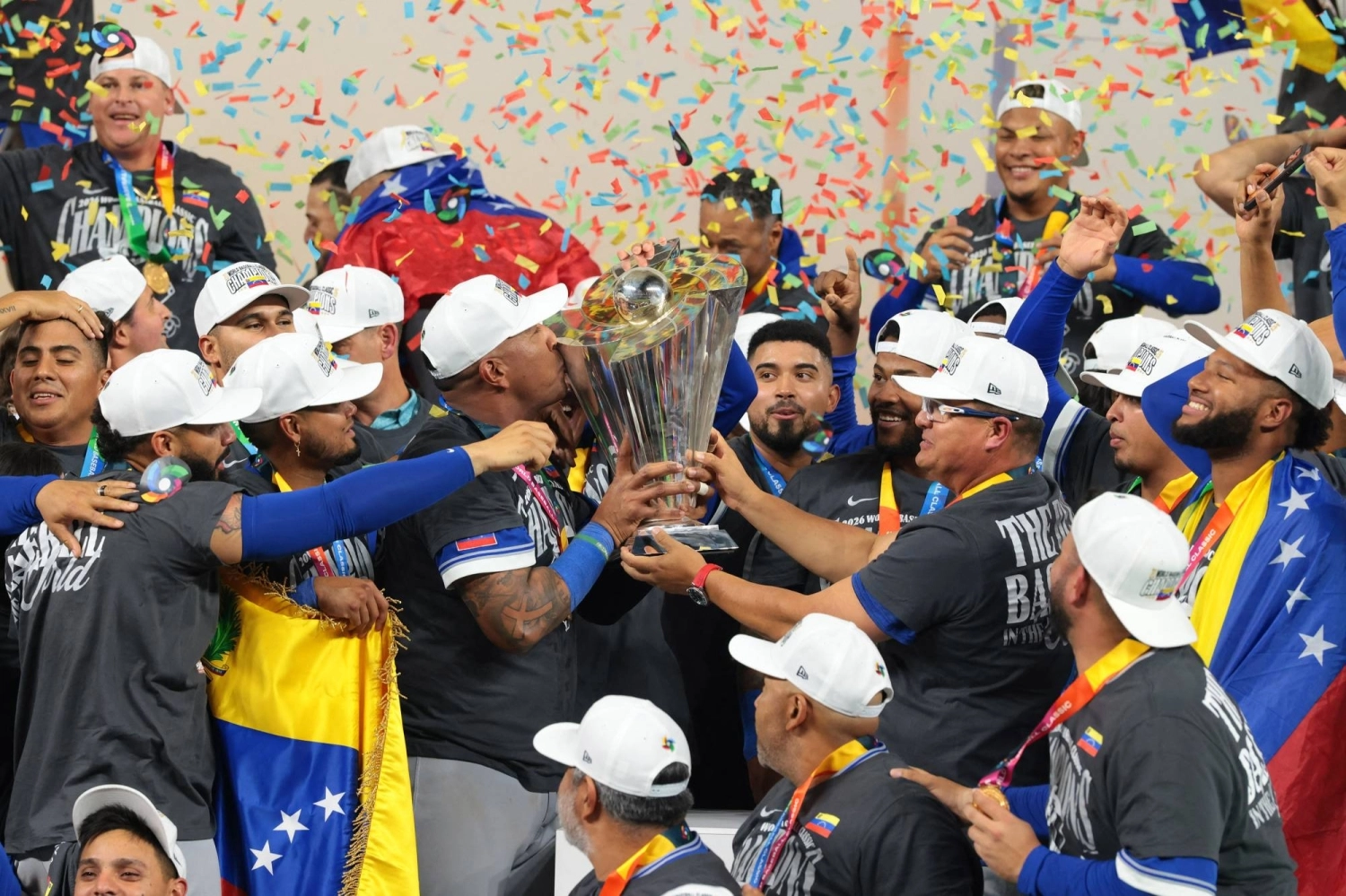
The geopolitical tension between these two countries served as a tense backdrop for the baseball game that played out, with Team Venezuela ultimately prevailing 3-2 in front of an overwhelmingly pro-Venezuelan crowd.
The cheers echoed from Miami to Venezuela, where families watched in their homes, neighbours gathered around outdoor televisions in public parks, or large crowds gathered in squares. For the first time, Venezuela had become the world champions of their favourite sport.
Over the next few days, streets flooded with excited fans who hosted impromptu parades, often using the characteristically Chavista method of motorbikes to get around (they are often seen in Venezuela’s over nineteen-thousand communally-run neighbourhoods). The WBC trophy was officially transported to Caracas, where interim president Delcy Rodriguez lifted it high in front of an immense crowd.
At the conclusion of the WBC final, commentator Joe Davis exclaimed: “Venezuela – The Best in Baseball!”
Davis perhaps missed a larger point: For a country so vilified, so targeted, and yet so steadfast and so passionate – this victory means far more for Venezuela than just Baseball.



Leave a Reply to ΜΙΧΑΗΛ ΜΑΥΡΟΠΟΥΛΟΣCancel reply