
The below article is republished from Left Views. Red Spark was represented at Hands Off Asia conference by Nick Dobrijevic who presented on the panel “Debt, Tariffs, and the New Economic Siege: Sovereignty Under Assault.”
Iran’s confrontation with American imperialism highlighted a broader agenda at the recent Hands Off Asia conference in Colombo. The event convened activists, scholars, and political leaders from across the Global South to challenge foreign military expansion, economic dependency, and technological control. Delegates adopted the landmark Colombo Declaration, calling for sovereignty, non-alignment, and people-led development throughout the region.
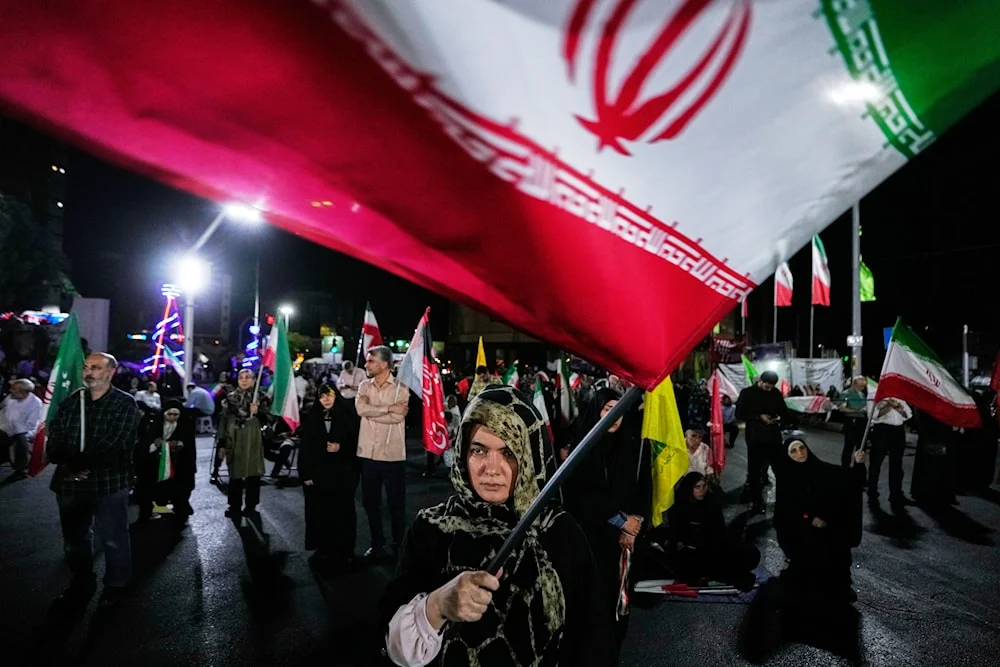
Colombo, Sri Lanka: What is Iran thinking? Even as the United States has been conducting hundreds of air attacks on Iran over the past 10 days, the Asian country is in no mood to back down.
“We have strategic patience, and we are very willing to pay the price against US imperialism,” said Dr Setareh Sadeqi Mohammadi from the Faculty of World Studies at the University of Tehran, at a conclave organised by the International Peoples’ Assembly (IPA) and Tricontinental: Institute for Social Research in Colombo, Sri Lanka.
Iran is exercising a ‘spatial veto’ by using its geographical advantage over the Strait of Hormuz to defy US sanctions, added Dr Mohammadi, speaking on an all-women panel, remarkable in itself, on the theme ‘Militarisation of Asia and the Architecture of Confrontation’. It was the first panel at IPA’s three-day Hands Off Asia conference, held from 16-18 July 2026 in Colombo, Sri Lanka.
More than 70 delegates from 17 countries, representing 43 organisations, including scholars, peace advocates, activists, leaders of people’s movements, politicians, trade unionists, revolutionaries, and artists, came together to echo “a people’s call for sovereignty and solidarity”. The Hands Off Asia campaign advocates for the removal of foreign military bases, an end to aggressive military pacts, and freedom from economic and financial coercion.
Asia needs a common development agenda focused on human needs and climate change vulnerability, said former Nepalese prime minister Pushpa Kamal Dahal ‘Prachanda’ during the inaugural plenary session of the conference, titled ‘Building a Unified Front for a Sovereign Asia’. “The emerging multipolar world must avoid replicating old power structures,” added Dahal.
Welcoming the delegates to his country, Sri Lanka’s Cabinet Minister for Environment, Dr Dammika Patabendi, said, “Social transformation is possible when political movements build alternatives rooted in popular struggles.” A year and a half ago, Sri Lanka delivered a socialist mandate rooted in the realities of its people, he said.
A left government comes to power to fulfil the aspirations of the people; not for political power, but for social power, said Vijay Prashad, director of Tricontinental: Institute for Social Research. The ‘Gen Z’ movements that emerged across South Asia are not merely student movements, he said.
“They are a class struggle, and we need to be among them and sharpen these class struggles. Hands Off Asia is more than closing US bases; it means allowing the people of Asia to determine their destiny. Hands Off Asia means socialism,” Vijay Prashad said.

With seven panels and two plenary sessions spread over three days, the conference culminated in the adoption of the Colombo Declaration. The declaration demands from the West: an absolute end to military encirclement (rejecting AUKUS, the Quad, and foreign bases), an end to economic bondage (defying the IMF and tariff coercion), political self-determination free from regime change, and the right of Asian peoples to dismantle cultural colonisation and write their own histories.
US Military Expansion and the GDP Drain in Asia
The meeting highlighted how Washington’s geopolitical strategies treat Asian nations not as sovereign states, but as front-line outposts for its military expansion.
Under the ‘America First’ doctrine promoted by figures such as US War Secretary Peter Hegseth, recently at the Shangri-La Dialogue in Singapore in May 2026, allied nations face intense pressure to allocate sizeable portions of their GDP towards defence and ‘interoperability’ mandates that force them to purchase identical weaponry. In the Philippines, as Corazon Valdez Fabros of the International Peace Bureau and STOP the War Coalition revealed, this forced military expenditure eclipses the country’s budget for vital social services. The Philippines, she warned, is effectively being transformed into a vast US naval and logistical corridor designed to contain China.
The speakers described the physical, psychological, and ecological toll of this militarisation:
Okinawa, Japan: Dr Keiko Yonaha of the No More Battle of Okinawa movement detailed how 70% of Japan’s US military facilities are concentrated on an island that accounts for just 0.6% of the country’s national territory. The US and Japan have designated Okinawa as the frontline of a ‘Taiwan Contingency’, with the island serving as a base for potential US intervention in the event of a crisis in the Taiwan Strait. Dr Yonaha spoke about sexual violence committed against Okinawan women and children by US troops since 1945, alongside ecological destruction, which local authorities are unable to investigate due to unequal Status of Forces Agreements (SOFAs).
The Philippines: Fabros highlighted the creation of a 4,000-acre high-tech manufacturing zone near New Clark City for Pax Silica, a US-led technology manufacturing hub. The US has sought legal exemptions and diplomatic immunity for up to 99 years, effectively creating a neo-colonial enclave.
Taiwan: Dr Meei Shia Chen of the Diaoyutai Education Association discussed what she described as deep ideological and military control exercised by the US over Taiwan, treating a province with thousands of years of historical ties to mainland China as a dangerous geopolitical pawn. “Ideological control is exercised through textbooks,” she added.
The existence of US military bases in Asia creates strategic pressure. “The base is a political instrument,” said Prashad. “What the Iranians have demonstrated is that a US military base is not a shield; it is a target.”
South Korea Blueprint
Military interventions in US-allied countries cripple national independence. Jeong-eun Hwang of the International Strategy Center (South Korea) presented a detailed account of how Washington forces its junior partners to absorb the costs of empire under the guise of geopolitical ‘pragmatism’.
Following the US announcement on 29 October 2025 of a blanket 15% tariff on South Korean products, Seoul has been pressured to escalate its military footprint. South Korea is projected to spend USD 350 billion in total military expenditure, including USD 25 billion designated for the purchase of US weapons systems and USD 33 billion directly allocated to support the US military presence, with the immense economic costs passed directly on to Korean workers.
Hwang revealed that South Korea is spending 3.5% of its GDP on the military, matching the spending targets established at NATO’s June 2025 Hague Summit (despite South Korea being neither a NATO member nor a signatory to the declaration). She said that the 28,500 US troops stationed across 70 to 80 bases act not as a defensive shield but as an occupying force, drawing South Korea into Washington’s containment strategy against China. Furthermore, US restrictions on global semiconductor supply chains mean that, despite possessing world-class technology, South Korea is denied technological sovereignty.
Beyond military might, delegates at the Colombo conference outlined the mechanisms of US economic imperialism, which they argued strike directly at political, social, and digital sovereignty.
Debt Trap and Structural Adjustment
The old colonial forts of Sri Lanka, built by the Portuguese, Dutch, and British, should be left in ruins rather than restored, said Dr Ahilan Kadirgamar, senior lecturer in the Department of Sociology at the University of Jaffna, Sri Lanka. “Because that is the only true legacy that colonialism deserves in Sri Lanka,” he said.
Other speakers who drew directly from Sri Lanka’s ongoing crisis included Dr G. Weerasinghe, general secretary of the Communist Party of Sri Lanka. He said that the island nation is being drawn into the US Indian Ocean strategy after its sovereign debt exceeded USD 50 billion in 2022.
In his remarks during the concluding session of the conference, he spoke about how the International Monetary Fund’s structural adjustment packages, imposed since 2023, had constrained state revenue, forced tax concessions for large capitalists, and eroded the country’s social fabric. “Non-alignment should be presented as an idea to the people of Sri Lanka,” Weerasinghe added.
Similarly, Agustino Perez of the Socialist Party of Timor-Leste spoke about the vulnerability of small nations, noting that just 11 hours after the restoration of its independence in May 2002, Timor-Leste was forced to sign away rights to its natural resources. From Bangladesh, Dr Farheen Alamgir noted how external pressures and the privatisation of critical infrastructure, such as ports, to foreign entities with US ties undermine state autonomy, even as the country resists joining the Washington-led Quad alliance.
Dr Taimur Rahman, general secretary of the Mazdoor Kisan Party (Pakistan) and associate professor of political science at the Lahore University of Management Sciences (LUMS), presented macroeconomic figures showing the human toll of sovereign debt bondage. UNCTAD data from 2024 shows that the external debt of low- and middle-income countries reached a staggering USD 11.7 trillion. Debt servicing has reached a 50-year high globally, leaving two out of every five people in heavily indebted nations, where a mere 18% of government revenue is spent on public services.
Pakistan, he said, owes USD 130 billion in external debt and spends 55% of its revenue on debt servicing, while 20% goes towards the military. This leaves almost nothing for infrastructure, development, healthcare, or public education.
Benyasiri Eimviriyapong from DinDeng in Thailand exposed how the monarchy–military complex and elite-led political movements in her country have exploited the rural working class while concealing their underlying class structures.
Digital Public Square Under Siege
From Indonesia’s Megawati Institute, Dr Hilmar Farid, scholar, cultural activist, and lecturer, explained how the infrastructure of the modern empire has evolved. Today, Western corporate monopolies and algorithms control the digital public square, with allied countries providing the institutional framework designed to manufacture consent and fragment progressive movements.
“We in Southeast Asia are a periphery adapting to the changing core. We must exploit the cracks of the dominant core to further the transformation we seek,” Farid said.
Balram Prasad Banskota of the Nepali Communist Party had earlier argued that technology should strengthen democratic processes rather than drive social fragmentation.
Luiz Zarref of Brazil’s Landless Workers’ Movement (MST) echoed this view, asserting that achieving digital sovereignty and gaining control over technologies such as digital agriculture are essential to breaking the Global North’s monopoly.
Citing the example of IARAA (Artificial Intelligence for Agrarian Reform and Agroecology), an open AI platform developed by MST and its partners, Zarref said: “Science and technology should be one of our pillars in internationalism. We should provide the solutions to our people. We should know how to manage nature, and we should know how to work with science and technology for our own people.”
Fatima Shehzad of the Progressive Students’ Federation, Pakistan; Muhammad Zikri Bin Abdul Rahman of Pusat Serarah, Malaysia; Aishe Ghosh of Jawaharlal Nehru University, India; and Khyl Ashlee Ramos of the Party of the Labouring Masses (PLM), Philippines, also spoke on the panel titled ‘The Far Right, Authoritarianism, and the Domestic Infrastructure of Empire’, drawing on experiences from their respective countries.
Chinese Alternative to Tech Imperialism
“The US hopes to foreclose any possibility of China or any other country competing with it in the field of artificial intelligence,” said Jeff Xiong of the Center for Global South Studies at East China Normal University (ECNU).
Xiong warned that AI is not merely a tool; it is a foundational global infrastructure that will penetrate every aspect of human activity. If a single country subordinates others in AI development, it would create a new and dangerous paradigm of technological imperialism.
Currently, China is the only nation capable of competing with the US in this arena, effectively challenging the US technology blockade, as evidenced by Huawei’s growing share in global AI chip markets, Xiong said. Looking towards solutions, he detailed how China has committed to supporting the Global South through technological assistance and scholarships.
He outlined key strategies for developing nations:
- The ‘AI+’ model: Integrating AI as an enabler for core sectors such as industry, education, and agriculture, rather than treating it as an isolated software sector.
- Rejecting victimhood: Empowering “barefoot developers” to build grassroots applications from the bottom up, as seen in projects implemented in Rongjiang, rather than waiting for technological elites to dictate how technology should be used.
On 16 July 2026, representatives from 29 founding countries officially established the World Artificial Intelligence Cooperation Organisation (WAICO) in Shanghai. Headquartered in the city, the intergovernmental body is designed to facilitate collaboration, knowledge-sharing, and regulation of the digital public square, presenting an alternative framework for the Global South.
View from the Imperial Core
Nicholas Dobrijevic, representing Red Spark (Australia), provided an essential perspective from within the Global North. He emphasised that while Australia’s domestic capitalist ruling class has grown stronger, operating on long-standing racist and chauvinistic traditions, the country also possesses a rich internationalist legacy rooted in its trade union movements.

Dobrijevic noted a dangerous geopolitical shift: although China remains Australia’s largest importer of goods, Canberra’s new military alliances with the US mark a shift towards alignment with American imperialism.

Leave a Reply