
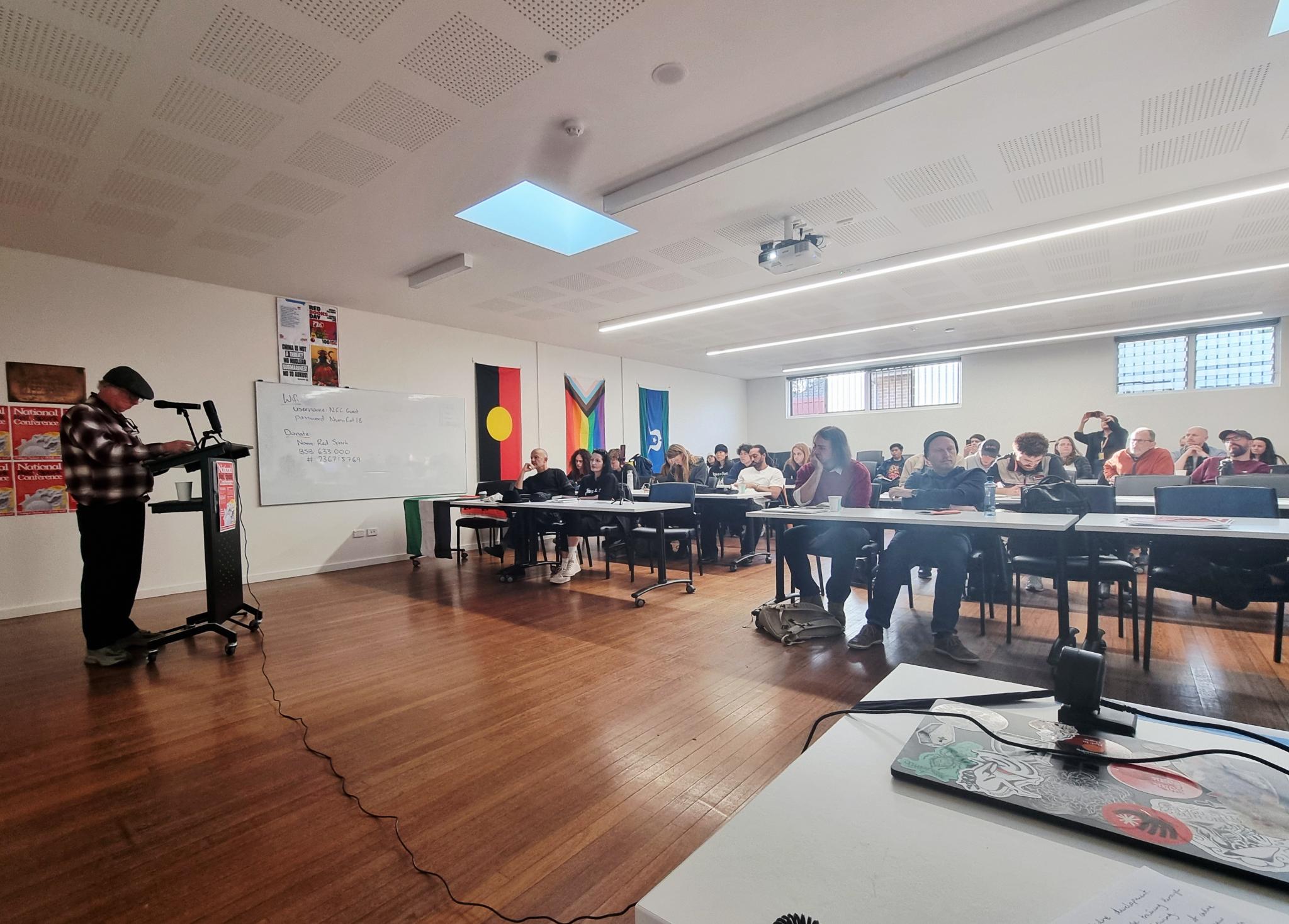
The following is the keynote talk given by Max Lane to a public session at the Second National Red Spark Conference held in July 2026 and attended by around 50 people. Max is a long-time socialist, author and specialist on Indonesia, translator of novelist Pramoedya Ananta Toer, former National Executive member of the Democratic Socialist Party (disbanded in the early 2000s), and member of Red Spark. In this talk, Max makes the case for socialism and the need to build an organisation capable of bringing it into being.
Good afternoon, comrades. It’s very good to see the room pretty much full—very gratifying for anyone who’s been involved in trying to build a little organisation for so long. I would also like to thank, in particular, the Red Spark National Executive for inviting me to speak. I know Red Spark meant well, of course, but on my 75th birthday last January I retired from the National Executive. So, I think it’s very much a project of making sure that Red Spark grows and becomes the kind of force that Joe, speaking from the United States, was talking about—something led and organised by people who are much younger than me.
The world is on fire. That includes, as Joe said, the terrible wildfires emerging across many countries due to the speed-up of global warming. But it is also on fire because of the wars and resistance that are underway today.

In Iran, can you imagine—according to the announcements of the Iranian government, confirmed more or less by the Trump regime in the United States—more than 20,000 bombing raids were carried out on Iran, obviously with enormous human costs and terrible destruction to infrastructure. Even though the United States has been limited by its own propaganda justification for the war—that it is a war against the regime, not against the people. So at least for the time being, people living in the cities and towns of Iran are not being subjected to the carpet bombing that we would see if the Iranian people themselves were declared the enemy. But of course, Trump and company thought initially that knocking out the leadership of Iran would cause the people to revolt, so they have to sustain that line for the time being—so we should be on alert if that propaganda changes. And we know there is still the Israeli-Zionist occupation of South Lebanon, and the ethnic cleansing associated with that.
We’ve heard messages from Cuba burdened with a truly existential embargo being tightened and tightened against the Cuban people.[1] We see the resistance of the Cuban government taking emergency measures to try and ensure they can sustain the needs of the population. Very importantly, we will need to see the protest movement and the left in the US grow and carry out more activity, as well as here in Australia, which Red Spark is committed to. We see the long-distance occupation of Venezuela, including naval pressure, primarily via the embargo and the overwhelming shadow of great military force. Africa, Latin America, and other countries face constant warfare by the United States and other imperialist countries against the peoples of those regions.
And of course, Palestine: the destruction of Gaza, the displacement of almost two million people. This activity is now also spreading to the West Bank, intensifying there. Palestine is in some ways the worst example of the fire directed by the imperialist powers at the peoples of the world. In Australia, we have to look at the virtual surrender of the Australian government to the pro-Zionist cause—even with a slight change in rhetoric a year or two ago regarding recognition of a Palestinian state. Now, the Zionist version of the campaign against so-called antisemitism is basically the official policy of the Australian government.
All of this is underpinned by the reality of the global divide. In Israel and Palestine, there is a wall separating the two: people living middle-class lives on one side, and people living devastated lives on the other. But that division is not just between Israel and the occupied territories; it is a wall that divides the whole world. 85% of the world’s population lives in the Global South, but they enjoy only 15% of the wealth. The Global North, with 15% of the population, controls 85% of the wealth. That’s another wall—maybe the wall—that divides the world as a whole.
But it’s not just Global North versus Global South. Class divisions and class struggles define political, economic, and social life inside all countries, including imperialist countries. We had a great explanation of the situation in the US from Joe of the Party of Liberation and Socialism in the USA this morning. I agree with him very much: the days of action in Minnesota – the general strikes and protests against Immigration and Customs Enforcement (ICE) – were real signs of the potential for the tide to turn. But as Joe said, if the storm is coming, make sure you build the ship. You can find similar sorts of right-wing surges and counter-surges in other parts of the imperialist world as well.
Even when we look at exploitation, racism, and class struggle in various imperialist countries, we can still see that the majority of the working class, the left, and progressive forces are still small, with much of the working class disorganised and union membership in many countries having declined sharply during the 40 years of neoliberalism. In that context, the shrinking of the organised revolutionary left means conceptual leadership among those who might be starting to organise is also very weak.

This question of leadership, conceptual leadership—working out what the next steps are and what the big picture is—has always been important in the history of the socialist and communist movements, but it’s even more important today. We should not underestimate just how complicated the world has become, and how completely confusing it is for so many people. Two or three hundred years ago, humankind was often confused by the natural world, giving rise to conspiracy theories, in ancient times gods living on Mount Olympus, or beliefs in supernatural beings. But with the development of science over the last 200 to 300 years, our understanding of the natural world has vastly improved. Today, the confusion is over how to understand the social world.
The socio-political and economic world has now become more global and interconnected, accelerated by technology and what Marx called the socialisation of production—international supply chains. For a citizen in any country, imperialist or exploited, understanding what happens on a day-to-day basis is more and more of a challenge. Political organisations that can offer conceptual leadership—which, to understand the capitalist and imperialist era, must be Marxist—are more and more urgent. In other words, a revolutionary party is more and more urgent.
Let’s bring it back to where we live: Australia. We are all here because we feel and understand that something is not right. Australia currently produces enough food annually for around 70 million people, and exports about 70% of what it produces. How come, then, that more than 800,000 people every month line up to get food from charity organizations? The Foodbank Hunger Report 2024 found that 3.4 million households experienced food insecurity in the past year. How is that possible in a country of 25 million people that produces enough food for 70 million?
We know the basic statistics of wealth distribution in Australia: according to the Australian Council of Social Service (ACOSS), the top 10% of the population controls 46% of the wealth, while the bottom 60% holds only 17%. This concentration of wealth takes place in an extremely rich country. According to UBS data, Australia’s average wealth per adult is around A$894,000, placing it among the wealthiest countries in the world. Gross domestic product (GDP) per capita is around US$65,000 to US$67,000 a year, according to International Monetary Fund (IMF) estimates. Excluding micro-countries like Luxembourg or Brunei, Australia is one of the richest countries in the world per capita. Yet surveys by Finder suggest that around 40% of Australians have less than $1,000 in savings, and roughly one in five reports having no savings at all. Two in five Australians have no buffer that would last them more than three months if they were out of work.
The policies that led to this over recent decades—starting with neoliberalism in the early 1980s under the Labor Party—have been continued, unbroken, by whichever party or coalition has been in government. This brings us to a peculiar situation: precarity in the midst of abundance. You have precarity in one of the richest countries in the world.
If you look at First Nations people, a majority live on incomes below the median, and their life expectancy is around eight to nine years shorter than non-Indigenous Australians, according to Australian Institute of Health and Welfare (AIHW) data. Worse than that, they are still murdered in jail today, and racism still negates them as a people.
How do we change things? Who can change things from a capitalist-run society to a socialist- and humanist-run society? That change can only be made by a majority of the population—or a majority of active citizens—organised, collectively struggling, with a high level of consciousness. The masses, the working class. But those millions of people have to want to do it. They have to be convinced that it is worth doing, that it can succeed, and that the struggle is worthwhile, knowing full well that any serious struggle to change society in such a radical way will bring sacrifice and hard struggle.
How can the masses of people be convinced of this need? In a period where we are not in a revolutionary crisis, that process is going to be slow. In the meantime, what is our most urgent, immediate need? We need platoons—in fact, we need battalions—of convincers: people who can convince others that it is feasible and necessary to change society.

In Australia, union coverage has decreased dramatically since the 1970s, when it was 70% to 80%. Civil society organizations that were strong in the 50s, 60s, and 70s have withered away during the 40 years of neoliberalism. So, we have to find ways to reach out to people who are no longer organized in unions or other collectives. You can’t do that by yourself, and you can’t do it casually. You need people who are engaged and active in whatever campaigns are around, but who are also trained to be good convincers. Based on Marxist science, they can understand how capitalist society works, study the experience of previous revolutions, draw lessons from them, and work out the methods for building an organisation that can be the ship when the storm comes.
There is no secret recipe or message to solve the problem. It is a matter of making the commitment, being convinced of the necessity and feasibility of change, and continuing to work on building the organisation, campaigns, and movement. We have to attract people to join organisations to become cadre, or to help organisations that are trying to do that.
Currently, an organisation with that orientation—with a strong emphasis on anti-imperialist activity, solidarity with movements in the Global South, while focusing on confronting the capitalist class in Australia and winning demands for wealth redistribution and climate policy—is heading towards that ultimate goal of being that ship.
Beyond the material precarity, there is another aspect to life in Australia: a sense of entrapment. I was talking to a comrade over dinner the other night who commented that along with precarity, many young people feel trapped by their material conditions. You can’t escape the necessity to think about money, or the constant reminders of your precarious situation—whether waiting for a roster call or filling out bureaucratic employment forms. You are chained.
One of the slogans of the Bolshevik Revolution was: “You have nothing to lose but your chains.” Here in Australia, we have chains in the midst of abundance. What is crazier than that? Food insecurity in a country that produces food for 70 million people, and a sense of entrapment amidst abundance. Some of the largest industries by turnover are those built around distraction and escape—gambling, mass tourism, and popular culture—designed to give you a temporary sense of escape from your chains. I am not sure they are the single biggest industry by turnover, but they are undeniably enormous, and their social function is to distract.
How do we overcome that sense of entrapment? You can’t overcome it until the system is completely changed. But what do we do in the meantime? Are we going to be satisfied with this or that distraction? How can we fully develop our human potential? Marx summed up the essence of the future communist society in the Communist Manifesto as: “The free development of each depends on the free development of all”—the free development of your human potential, talents, and capacities.

The only way to safeguard our humanity and develop our capacity right now is by being involved in the struggle itself. There is no way to live a life beyond just distracting yourself if you avoid struggle, or if you avoid the reality of the necessity for change. Collective struggle means we will individually develop more as we struggle together with others, motivated by the goal of ending the terrible social system we live in today.
Any group that tries to convince larger numbers of people to struggle needs to show that there are already people saying and doing this. The more, the better. I want to read a message from an overseas comrade, Daniel Indra Kusuma, an Indonesian political activist. In the early 1990s, he was a central leader in establishing a party of young people, the People’s Democratic Party (PRD), founded in 1994, which became the spearhead of the movement to overthrow the military dictatorship of Suharto. I was in the Democratic Socialist Party (DSP) then, and one of my tasks was organizing collaboration between the DSP and the PRD.
Daniel sent this message to Red Spark:
“To the comrades attending the National Red Spark Conference: I am incredibly fortunate and overjoyed to receive the news of the upcoming National Red Spark Conference. It is a sign that there are still good people keeping the struggle alive for a happier, revolutionary world. In doing so, you keep me alive, and my revolutionary spirit. I believe there will be many thorough and scientific discussions that will lead to a beautiful truth—that we can assess the current state of the world and find solutions, thereby making political practice easier and more feasible. Although the world of imperialism has been challenged by the progressive world, it has not yet been challenged sufficiently by the revolutionary world. Now is the time to advance it with the strongest of commitments, as this is what is demanded by objective historical conditions. Congratulations, and may you find joy in bringing about good within the conference.”
For me, he is an inspiration—active in politics since the 1970s, building a party that played a key role as a catalyst in overthrowing Suharto. After going through many trials and tribulations, he is still there in the midst of the struggle. Join, commit, struggle, see your own human potential develop, and envisage a world where the free development of each depends on the free development of all.
Thank you very much.
[1] https://red-spark.org/2026/07/31/greetings-to-the-red-spark-national-conference-from-the-embassy-of-the-republic-of-cuba-in-australia/



Leave a Reply