
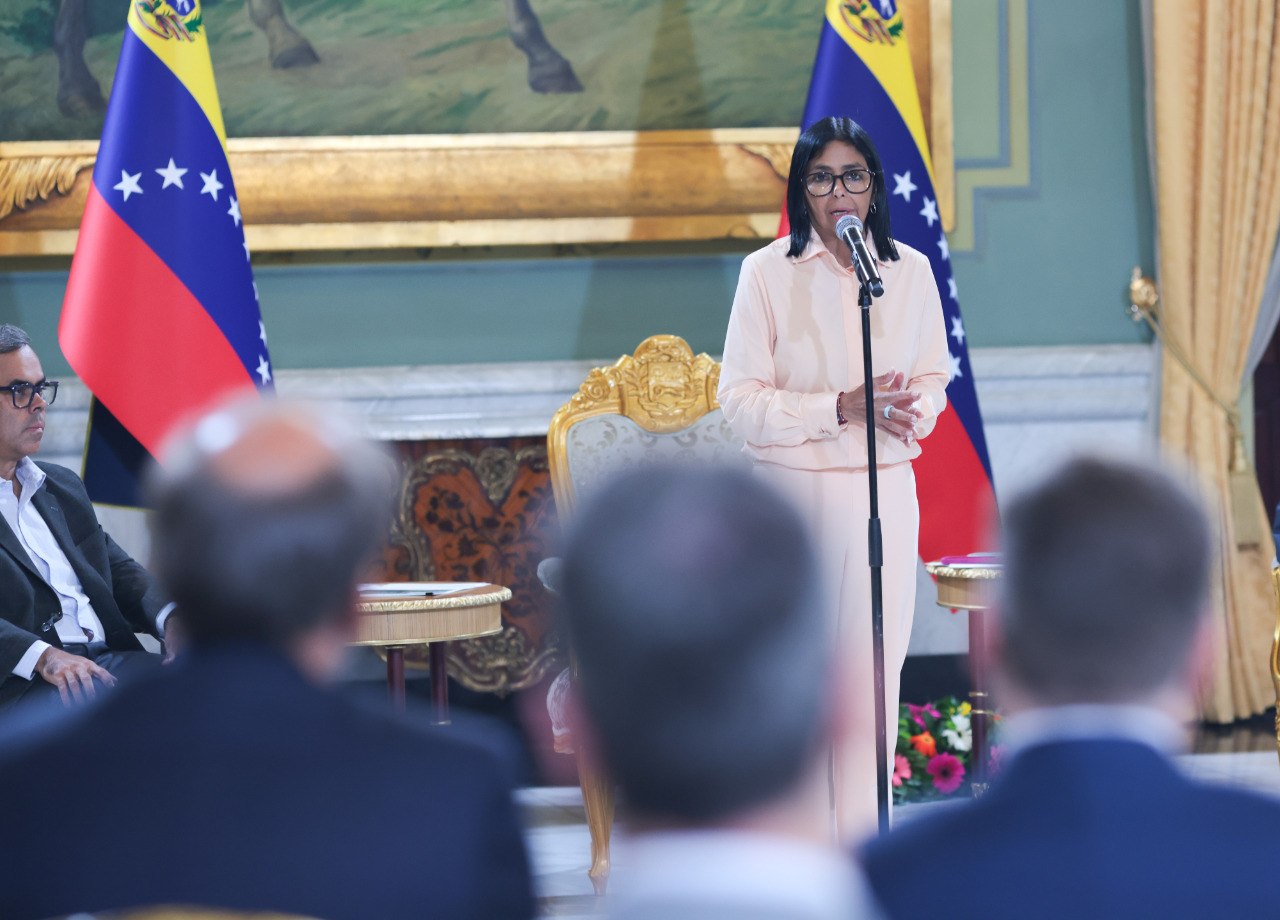
In 2024, Australian delegations were invited by Venezuela’s Simón Bolívar Institute (ISB) to attend the World Congress of Antifascist Youth and Students, organised by the youth wing of the governing United Socialist Party of Venezuela (known by its Spanish acronym, PSUV). Logistical challenges meant other invited delegates from the Communist Party of Australia and the Australia-Cuba Friendship Society were unable to attend, so I was the only delegate from Australia.
The November conference forms part of a larger series of PSUV initiatives to demonstrate global leadership in the antifascist struggle following Venezuela’s July presidential elections. The PSUV election victory triggered renewed attacks by imperialist forces led by the United States, in the form of new sanctions and intensified propaganda against the Maduro government. In Venezuela the preferred term for sanctions is “unilateral coercive measures”, which emphasises their intention.
In September, international delegates came together for the proclamation of an Antifascist International working group which was to reconvene after the November youth congress. Maduro also announced an international festival of antifascism in January 2025 to coincide with his reinauguration. The Youth Congress was held over three days starting on the November 20. On the first day, international delegates participated in a march through Caracas to celebrate the international day of students along with thousands of Venezuelan students from across the country.
Background to these events
These events must be seen in the context of the consistent pressure for regime change at any cost emanating from US imperialism for more than 20 years.
Action against the government of Venezuela with explicit or clandestine support from US officials has been a feature of Venezuelan politics since Hugo Chavez’s historic victory in 1998. It includes:
- In April 2002, Chavez was removed for 2 days during a military coup, whose leaders have claimed support from the US. Chavez was returned to the presidency due to overwhelming support and grassroots mobilisation that defeated the coup plot.
- In 2019, the US and its allies recognised Juan Guaido as president when he declared the election of Maduro to be illegitimate.
- Canadian-US mercenary Jordan Goudreau led a military incursion into Venezuela into 2020.
- Key members of the opposition, such as former mayor Leopoldo Lopez (also a mentor of Guaido) have openly called for overthrow of the Maduro government.
US president Barack Obama placed sanctions on Maduro, his family, and other members of the government over allegations of post-election repression in 2015. Trump added further financial sanctions in 2017, prohibiting access to US financial markets by the Venezuelan government, including state owned enterprises, most notably, the state owned oil company PDVSA. From 2019, Biden made gestures towards the exempting oil production from these sanctions. However as of December 2024, Secretary of State Blinken stated they will terminate all licenses allowing for transactions with PDVSA.
Before the July presidential election, the Western press extensively prepared the ground to make the claim that a victory for the incumbent, President Nicolas Maduro (of the PSUV and successor to Hugo Chavez), would be illegitimate. A big tent coalition of Venezuelan opposition parties under the title of Democratic Unity Platform (PUD) ran the relatively obscure diplomat Edmundo Gonzalez as their candidate, who was more or less a proxy for opposition leader Maria Corina Machado. Machado, who was barred from running for office due to charges of treason related to her alleged support for the overthrow of the Maduro government. Machado was one of the coup leaders who entered Miraflores Presidential Palace during the failed coup attempt against Hugo Chavez in April, 2002.
The United States has now recognised Gonzalez as president. It has imposed sanctions on Venezuelan officials and their families, revoking approximately 2000 visas. Since 2006 it has also placed sanctions on arms transfers to Venezuela under the premise that the Maduro government is “not cooperating fully with United States anti-terrorism efforts” and because of allegations of financial support provided to Hezbollah.
Florida Senator Marco Rubio, who has been selected as Secretary of State in the next Donald Trump’s administration, is extremely hawkish when it comes to Venezuela. He has consistently called for the escalation of sanctions in order to produce regime change (the same policy which has been applied to his ancestral home of Cuba for over 70 years at the expense of the people). Rubio refers to Maduro as a ‘narco-dictator’ and views any relief of sanctions to be appeasement. He has also called for the Venezuelan government, and government-aligned Colectivos (militias and community organisations which support the government) to be designated as terrorist organisations.
There is debate within the Venezuelan revolutionary process that includes sharp criticism of Maduro. However, most of that comes from the former ruling class and their supporters. It scarcely needs to be said that aggressive US support for authoritarian regime change attempts to weaponise and escalate even legitimate criticism within the framework of advancing the Bolivarian process. This hugely complicates the process of discussion and debate within the framework of advancing the Bolivarian process. What is at stake in the case of Venezuela is geopolitically not a question of democracy or human rights, it is a straightforward case of a challenge to US hegemony within a region it considers as its backyard.
The Sword of Simon Bolívar
In the late 1980s, under the orders of the International Monetary Fund, then Venezuelan president Carlos Andres Perez began instituting deep and rapid neoliberal austerity. There were major cuts to social services and deregulation of prices, leading to misery across the country. This led to the largely spontaneous Caracazo uprisings in 1989 in which protesters clashed with violent police and troops. Some estimates put the number of deaths in the thousands. In the context of this widespread dissent, junior military officer Hugo Chavez decided to launch an insurrection in 1992 with his Revolutionary Bolivarian Movement-200 (MBR-200), to make the most of the initiative of this revolutionary situation. Though this insurrection failed, and Chavez gaoled, his popularity secured his release and he was able to win the presidency in 1998.
There is a story that Che Guevara, on meeting with Chilean president Salvador Allende, gave him a copy of his book on guerilla warfare with the inscription “to Salvador Allende, who seeks the same ends by different means”. Leftists in countries like Australia in the face of what appears to be overwhelming power of the ruling class, can come to the conclusion that reform is directly opposed to revolution. However, Venezuela and numerous other examples shows us that this dichotomy is counterproductive. Chavez came to power through electoral means, after attempting an uprising, and his electoral success was built on the popularity his movement gained through the insurrection. This dialectic of reform and revolution remains a feature of the Venezuelan project until today.
Understanding Venezuela
Two books I read prior to travelling to Venezuela were Building the Commune by political scientist Geo Maher and Communes and Workers Control in Venezuela by Dario Azellini. I’ve also drawn on conversations that I had with Venezuelan academic Andres Antillano, as well as a few other resources which I will reference.
The concept of nationalism itself is strange coming from a country like Australia, one of the imperialist societies, where nationalism is inherently linked with chauvinism and white supremacy. In Venezuela it may seem contradictory on the face of it for a socialist movement to claim the myth of an aristocratic, republican general such as Simon Bolivar. Azzellini addresses this as follows:
It is completely out of place for bourgeois historians to contradict the Bolivarian revolutionary interpretation of struggles of the past. On the one hand history has no objectivities and is subject to interpretation; on the other, the revolutionary interpretation has lessons for the present: only when Bolivar integrated his movement to include those from below and recognise some of their claims did the movement triumph.
This is instructive because the construction of revolutionary leaders during the Spanish Empire is not some kind of blind nostalgia or folklore, but a deeply intentional claiming and repurposing of the past for a revolutionary purpose. Bolivarianism then is something far different from the racist patriotism of exclusion but the basis for an inclusive transformation of society. This inclusion on multiple fronts has become the characteristic of the Bolivarian process. There are a multiplicity of actors involved from the community level, the cooperative sector, the communes interacting with the state at times in concert and at times in conflict. The state, as formal power was taken by Chavez in 1998 is not the end point of this struggle but is rather able to enable the inclusion and empowerment of these various actors to become owners of the revolution itself.
Geo Maher writes of Chavez’s last speech before he died, in which he called for a “Golpe de Timon” or “Strike at the Helm”. From his first term, Chavez undertook a series of popular referendums in order to reconstitute power within the republic. These provided legitimacy to social forces outside of the liberal state apparatus to take ownership over issues that concerned them. To this end in 2006, the government established a process for building communal councils, a building block for the socialist democracy which was eventually to make the state redundant (recalling Marx’s proscription for the withering away of the state after a period of proletarian dictatorship). Chavez’s call to ‘strike at the helm’ was his articulation for the development of socialist democracy at every level in the country, the workplace, the school, the neighbourhood, and not to wait for socialism to be instituted from above.
What next for the revolution?
Without a doubt, with the death of Chavez, the Bolivarian process lost its most authentic champion, with Nicolas Maduro struggling to live up to the same role. Geopolitical changes throughout Latin America, including the ascendancy of the far right in places like Argentina, have also contributed to Venezuelan regional isolation. Venezuela is seeking to align itself with a broad heterogeneous anti-hegemonic alliance of Iran, Russia, Cuba, and China in an attempt to create a stronger balance against US expansion on a number of fronts. The 2024 anti-fascist congresses demonstrate an attempt to take a position of leadership in championing international liberation struggles, particularly Palestine. If Rubio’s past remarks are anything to go by, Venezuela is likely to face a renewed assault under the Trump presidency.
Australia’s complicity in that assault is likely to follow Australia’s weak response to injustice in Cuba. The Australian government and press will continue to prosecute an extremely biased version of events in Venezuela, platforming voices from the far right, and failing to incorporate the historical context of any internal disputes. It falls to smaller, left-wing groups to play a role in circulating a more accurate picture of the process underway in Venezuela and pushing back against simplistic narratives which ignore the role of imperialism. I think that the Bolivarian revolution also challenges us to consider the ways in which we imagine revolution taking place even in a country like Australia and the necessity to utilise (strategically) all avenues of struggle where there is opportunity to build democratic power.

Leave a Reply