
PART TWO: THE SHADOW BENEATH DUBIOUS METHODOLOGIES
This is the second in a now four-part series on Domenico Losurdo’s and Gabriel Rockhill’s critiques of Western Marxism and their advocacy of a “new Stalinism.” The first part introduced Losurdo and Rockhill’s arguments and examined their unsustainable critique of former New Left Review editor Perry Anderson. This part locates the source of Losurdo and Rockhill’s misjudgements in their dubious methodologies, themselves underpinned by a refusal to engage in any historical materialist account of the record of Stalinism. Part Three will propose an alternative, historical materialist definition of Western Marxism.
Unity of Methodological Flaws: From Losurdo to Rockhill
Domenico Losurdo and Gabriel Rockhill make a foundational distinction between Western Marxism and Eastern Marxism: Western Marxism is messianic and utopian and consequently refuses support for “actually existing socialism,” Eastern Marxism is realistic and sober and understands that the principal contradiction of capitalism is between imperialist and Global South nations. They focus overwhelmingly on the conflicts between nations and effectively erase their interplay with class struggles within these nations. Part One of this series showed that to sustain this dubious dichotomy, Losurdo and Rockhill systematically misrepresent various Marxist thinkers – the example used was Perry Anderson (for a larger survey of misrepresented Western Marxist thinkers, see David Broder and Ross Wolfe).1 The result is a scatter-gun approach that confuses friends with enemies, enemies with friends. In the end, only a very few can neatly fit into this bipartite schema as “Eastern Marxists” – Mao most obviously, an attenuated version of Lenin, a somewhat altered Marx, perhaps a few others.
From one angle, Losurdo and Rockhill’s over-large category of “Western Marxism” and their over-narrow category of “Eastern Marxism” present themselves as a problem of method. In Western Marxism: How it Was Born, How it Died, How it Can be Reborn, Losurdo’s method might more accurately be called “philosophical” or perhaps “Hegelian” rather than “historical materialist” or properly “Marxist.’ The two categories, “Eastern” and “Western” Marxism, expressions of opposites, exist like some iteration of the super-historical and transcendent “idea” which moves through history. Actual concrete analysis, careful evaluation of contexts and problems of the moment, subtle distinctions that make sense only within the specific conjuncture, are here erased by the logic of an argument. The result appears essentially idealist: Losurdo’s categories “exist,” and the task is to read history through them, fitting various theorists into the opposing categories as one goes.
Rockhill’s methodology in Who Paid the Pipers of Western Marxism? It is questionable in a different way. Rockhill restricts his focus to the way the Frankfurt School – Adorno, Horkheimer, Marcuse, Neumann – garnered money and career opportunities from the US State, whose goal was to build a Left “compatible” with capitalism. Rockhill’s chronicle of these careerist compromises is adequate, and there’s no need to substantially question his evidence. Yet the entire operation leaves the attentive reader with a distinct feeling of disquiet. To begin with, the Frankfurt School was among those “Western Marxists” who had the least connection to the organised socialist movement, effectively eschewing it before their relocation to the USA in the 1930s, with perhaps the exception of Marcuse during the 1960s. Their rejection of science and rationality, their academic lexicon, their bleak vision of society as bereft of progress – all these limited the scope of their work in the practical movement. This marginal position makes them less central to the construction of any “compatible Left” than “Western Marxists” with closer connections to the movement.2 It is not entirely clear why Rockhill chose them specifically as the subject of his study. As in the case of Perry Anderson, at the very least their most influential member, Herbert Marcuse, doesn’t fit neatly into an “anti-existing socialism” position, as David Broder reminds us: “far from dismissing Soviet Marxism, he wrote a respectful book about it, and still further from scorning anti-colonial revolutions, celebrated them, supporting in particular the struggle of the Vietnamese against American imperial attack.”3

Strangely, Rockhill avoids discussing the content of the Frankfurt school’s corpus – their critiques of reason and rationality, their writings on the culture industry, their use of psychoanalytic categories to analyse ideology and social reproduction. With one very brief exception (Marcuse on p.304 of Rockhill’s book), we never discover the substance of their positions, nor why they specifically, in Rockhill’s view, represent such a retrograde tendency. As with Losurdo’s account, Rockhill’s chronicle of the Frankfurt School’s careerism is mostly decontextualised. Their decisions are never really considered, as they mutate from conjuncture to conjuncture, never related to the ideas surrounding them at the time. Rockhill never explains: what about the Frankfurt School ideas, over the other anti-Soviet thinkers of the time, that were valuable for the elites? Why did these ideas find a hearing? Which sections of society did they speak to? What real problems were they grappling with? What were other Marxists writing and doing during each conjuncture, against which the Frankfurt school was staking its claims? What victories and defeats had occurred for the socialist movement during these times? What changes in social relations were occurring? Instead of engaging in such historical materialist questions, the Frankfurt school is depicted as floating somewhat in the aether, in a structured relationship with only two institutions: the state and the university system.
The Materialist Approach to History? Rockhill’s Narrow Vision
Rockhill does not fix the conditions of the Frankfurt School’s birth. This can be found elsewhere, in the words of their group biographer: “the Frankfurt School had come into being in part because of Marxist theorists’ attempts to understand the Sparticists’ [led by Rosa Luxemburg and Karl Liebknecht] failure to emulate in Germany what the Bolsheviks had achieved in Russia two years earlier.”4 This spurred related questions: why is the Western working class so integrated into the capitalist system and its ideology? During the interwar years and in exile from Nazism, Frankfurt School theorists increasingly concluded that domination operated not merely through economic exploitation but also through culture, rationalisation, and forms of mass consent. After the Second World War, they turned their attention to the stability of advanced capitalism and the apparent passivity of the working class. Their pessimistic conclusions led them to question any transformational project, with Marcuse remaining most committed to political change. The result was a theoretical model “virtuosic at critiquing the viciousness of fascism and capitalism’s socially eviscerating, spiritually crushing impact on western societies, but not so good at changing what they critiqued.” 5
What of the Frankfurt School’s decision to work with the US State, as part of a fight against fascism? Rockhill writes that “They were invested in anti-fascist politics within the confines of bourgeois democracies, which can be a laudable tactic, even though it is not a long-term strategy.”6 Rockhill presumably means as an employee of the bourgeois state apparatus, though he gives no summary of the conditions for such a laudable tactic. Perplexing in this regard is Rockhill’s lack of engagement with the official communist movement’s adoption of a similar strategy during the mid-1930s. The Popular Front strategy encouraged communist parties to ally with liberal and bourgeois democratic forces against fascism. At the Seventh Congress of the Comintern in 1935, General Secretary Georgi Dimitrov outlined this approach, which necessarily required the restriction of independent action of the working class in order to secure an alliance with those bourgeois liberal forces – thus submitting the working class to bourgeois hegemony “within the confines of bourgeois democracies.” Dimitrov argued that the anti-fascist People’s Front would allow for the formation of a worker-bourgeois coalition government before any revolution.7 In France, Spain, and elsewhere (in its early iteration, in China in 1927), this strategy shepherded revolutionary movements so that they remained within the limits of bourgeois acceptability.
Leninists typically reject the Popular Front for its failure as a socialist strategy. In a famous and well-documented example, as part of the Spanish Popular Front Government during the revolution of 1936-9, the Communist Party played a paradigmatically contradictory role. While it contributed a great deal in the military sphere, with its disciplined membership strengthening the Republican army, in the political sphere it disarmed revolutionary militia, discouraged land reform, demobilised working-class spontaneous action (including reversing factory occupations and other forms of self-organisation), insisted they would protect private property, and opposed national independence for Spanish Morocco (whose troops were a core part of Franco’s army) – that is, in what should be of central importance to Losurdo and Rockhill, they abandoned the anti-imperialist struggle. Spain was experiencing a “civil war” and not a revolution, they declared. With each month, the more conservative side of Stalinism came to the fore. In 1937, they actively repressed socialist and anarchist organisations to their Left, and subdued their own supporters, including members of the international brigades, who had grown disgruntled. All these measures were directed by the Soviet Government, who were driven by a desire to retain its alliance with capitalist France; the French had no interest in social revolution on its doorstep or liberation for colonies that bordered its own.8 The consequences for Spain were dire. Unable to muster popular political support by committing to revolutionary social gains – land reform (which would have won over the poor peasants), national independence for Morocco (which would likely have disintegrated the Nationalist army), workers control of both production and the State (which would have strengthened their alliance with both the working class and the anarchists who represented it) – the Spanish Republic was crushed by Franco’s “fascists” in 1939.
The defeat paved the way for decades of dictatorial rule in Spain and for Nazi Germany to hasten its plans for war. Participating in capitalist governments and subordinating working-class and mass activity to the needs of bourgeois allies not only weakened the revolutionary movement but diverted it into a capitalist program, not a socialist one. A thoughtful account of these events can be found in Fernando Claudin’s The Communist Movement: From Comintern to Cominform – a classic history of the Comintern. Claudin had been head of the Press Cabinet for Santo Carillo, Councillor of Public Security in the Madrid Defence Council during the revolution. He summarised the defeat: “All the sacrifice and heroism of three years went down with a policy that, from the first day of the civil war, had turned its back on the essential demands of Spanish revolutionary reality in order to adapt itself to the international strategy of Stalin.”9

The Frankfurt School’s decision to work for the US State, in order to fight fascism, was made only a handful of years after these events. That this decision was effectively a continuation of international communist policy puts their decision into a different light. Rockhill might have mentioned this, yet he seems to have no thought that this international precursor might be relevant. Instead, Rockhill passes from discussing the Frankfurt School straight to the non-sequitur, “The communists, it is worth recalling, are the ones who deserve the most credit for routing fascism.”10 The black and white worldview seems to have come home with a vengeance. The communists are either all good or all bad, and you must choose. Don’t mention the (Spanish) war!
The same decontextualization works its way through Rockhill’s entire book. Most importantly, he never describes the mass radicalisation of the 1960s, which saw Marcuse’s One-Dimensional Man become one of the books of its day among a New Left. He never investigates why this New Left arose in the first place, how they emerged also alongside the material changes wrought by the post-war boom, driven in part by a technological revolution and the emergence of mass culture, which drove a revolt against conservative social norms – it was a time of sex, drugs, rock and roll, and rebellion. He never analyses the way the Sixties radicalisation was primarily a youth revolt which worked around a conservative and stultifying official communist movement, and instead commits to various Left currents: autonomism, anarchism, Maoism, Guevarism, Trotskyism, Luxemburgism. Rockhill only offers a few lines on this, where he describes the new generation of radicals as undertaking a “demonisation” of the Old Left.11
Without examining these questions, Rockhill’s book reads like a police charge sheet against the Frankfurt School: a catalogue of betrayals, an accounting sheet marking connections, payments, speaking gigs, publication details.12 Texts are sometimes criticised for divorcing ideas from their historical contexts, but here the individuals are divorced from their context, and the ideas are absent entirely. Rockhill drifts into dangerous territory: his depiction of Western Marxism devolves into institutional reductionism, in which the CIA plans and funds ideologists and institutions in an immense project of mass psychological indoctrination, and this is what explains people’s adherence to capitalist ideology. In a podcast, Rockhill argues just such a position: he explains the Left’s “misunderstanding” of “siege socialism” and “actually existing socialism” firstly due to its ideological indoctrination by the bourgeois state.13
Rockhill here adopts a quasi-idealist model, in which (apparently passive) people are “misled” by ruling class ideas, an idea that is somewhat reminiscent of a conspiracy theory. This notion of ideology or consciousness has long been rejected by most Marxists, who more often begin with the question of why people adopt certain sets of ideas: what answers do they provide for real-life problems? In a similar fashion, the rise and fall of specific Marxist currents are usually related to the problems facing the movement, particularly its victories and failures. Ideological institutions are only one factor in this broader material context. We can agree with every piece of evidence that Rockhill provides, every historical event and social connection, and still be unable to explain why the Frankfurt School gained its audience, why the Sixties New Lefts emerged to become a core part of that audience, and why the Frankfurt School remains influential today.
Without the imperative to understand Marxist currents in relation to historically specific questions, there is nothing to stop Losurdo and Rockhill from extending their already over-extended category of “Western Marxism.” They can include within their boundaries various liberals, opportunists, and outright anti-Marxists since their criterion for inclusion is hostility to Global South struggles and to “actually existing socialism.” Why not simply extend the category to include all those who help to disseminate these ideas? As Rockhill admits, this social role has typically been filled by non-Marxists. From the 1980s onwards, this position was taken by post-structuralists, then post-modernists, then identity politics advocates. Their ideas spread throughout the institutions of civil society, were wielded by workers in NGOs, in HR departments, and by middle managers in public institutions. But here, there is no need to use the term “Western Marxism” at all. Nor, once we begin a more historically specific social analysis, is there a need for direct bribery, since this all operates as a system, one that was developed around the middle of the 1970s and consolidated during the 1980s, in part to co-opt and demobilise the radical movements coming out of the 1960s. This system required a social re-arrangement, new paths of career advancement, the creation of government departments aimed at liberal reforms, such as “equal opportunity legislation,” or the construction of academic departments focused on the history of oppressed groups. Former activists and sections of oppressed groups were incorporated into the upper echelons of institutional power – as long as they abandoned any mention of class and socialism. Their role was to disseminate capitalist ideology through practice, as organisers as much as ideas-merchants, and so to build socially progressive but economically neoliberal institutional cultures. In this new social arrangement, a new “common sense” (“socialism is a good idea in theory, just not in practice”; “we’re all just middle class,” “This department is the only place to create real change”; “socialism leads to authoritarianism” etc.) is as important as any high theory – though there is a connection between the two.14 It’s not clear how any of this might connect with Rockhill’s focus on the Frankfurt School, though perhaps a connection can be made. What is clearer is that only an idiosyncratic kind of Marxism can include within its definition of “Marxism” thinkers who resolutely oppose it – this peculiar operation is a sign that we should pay attention. Something peculiar is happening.
With his account reduced to the collation of bank receipts and the mapping of personal networks, Rockhill’s analysis ends up oddly depoliticised. Focusing on the Frankfurt School and its employment by the state draws our attention away from politics. It draws our focus away from the nature of the historic co-option of radical movements. It draws it away from the problems of strategic socialists faced, both before and after World War II. It draws us away from assessing the victories and defeats of the socialist movement, the immense upsurge in Paris in 1968, the Italian mass movements of the time, the victorious but limited Portuguese revolution of 1974, the failed attempts to reform the Eastern Bloc in Hungary in 1956 and Prague in 1968. It draws our attention away from the victory of the Vietnamese revolution in 1975, which marked the end of the long Sixties radicalisation in the West. It draws it away from the rise of neoliberalism and its reconstruction of economic relations and the body politic itself. These questions extend beyond issues of imperialism and “actually existing socialism” to issues of class struggle, especially within the West. It’s on these topics that Western Marxism makes the contribution it does, though it’s impossible to know this from either Losurdo or Rockhill’s books, since they contain such an extraordinary silence on the politics and history of socialist movements in the imperial core.
The Function of the Critique: Avoidance of the Problem of Stalinism
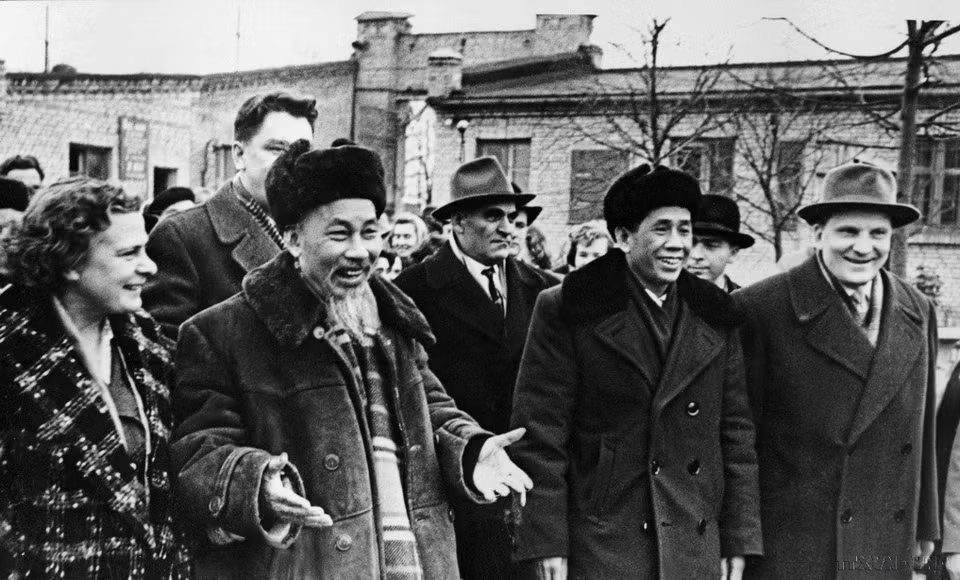
If Losurdo and Rockhill’s account of Western Marxism is impoverishing, so too is their picture of “Eastern Marxism.” As with their depiction of the West, the question of the political sphere within “actually existing socialist societies” practically vanishes, and consequently, different Marxist attitudes toward them can no longer be assessed. From this perspective, there can be no assessment of, for example, the political conflict between Ho Chi Minh and Le Duan during the 1960s, in which the former aligned more closely with the Third International strategies of his youth and then the current “peaceful” approach of the post-1956 Soviet leaders, the latter was more influenced by China and proposed a Maoist military strategy. The correctness of these two perspectives can only be judged against a concrete analysis of Vietnam during the 1960s, including the balance of political and military forces. It required an analysis of the class relations and struggle within Vietnam.15
How have Losurdo and Rockhill ended up in this unusual place? The secret driver of their methods, one suspects, is their desire to avoid any criticism of Stalinism. From their perspective, the tragic events in the USSR – forced collectivisation, the gulags and the purges, the 1936 and 1938 show trials, the surveillance state – were consequences of “siege socialism” (a term coined by Michael Parenti). They are the unavoidable results of the desperate struggle of the USSR to survive in the face of relentless imperialist aggression.16 Blame is projected outward, away from the Stalinist faction, and onto imperialism and its supporters, the “Western Marxists.”
Losurdo presents a quasi–historical justification of this position. Revolutions, he argues, pass through a utopian phase, filled with wild messianic visions typical of Western Marxism (represented by Trotsky in the USSR) and then to a “realist” phase (represented by Stalin). He applies the same logic to the Chinese Revolution. In both cases, Losurdo constructs history as a sequence of necessary stages in which revolutionary aspirations encounter objective limits and are corrected by reality. Facing the reality of siege socialism and the impossibility of earlier radical policies, Stalin becomes the figure of realistic institutionalisation in Russia. He accepts the need for state-building, the inevitable persistence of national questions, the rule of law, of constitutionalism, of a realistic international policy, and so on. Deng becomes the figure of realistic institutionalisation after Mao’s voluntarism. In both cases, the “realist” correction emerges as historically vindicated. Losurdo’s argument ends up as a kind of fatalism, common to some teleological versions of Hegelianism, in which all that did happen was rational and necessary.17 Competing alternatives were never alternatives at all. In this view, Stalinism is a necessary stage in the passage to communism, part of a larger process that unfolds as an apparently unilinear logic of progress. Stalinism cannot logically be anything but a step forward. Losurdo’s historical determinism structures his argument, helps him to select or dismiss various evidence, to emphasise or de-emphasise various facts, and thankfully erases other factors altogether.
This turns out to be a difficult task, because it is almost impossible to represent certain Stalinist events accurately without undermining the idea that they represented “realism” or progress. Radical surgery is required. Losurdo is forced to warp historical events to hold his argument together. For example, he has only one viable option for representing the Moscow trials as necessary – since there is no other credible evidence, he must accept the Stalinist regime’s fantastical concoction of “fascist conspiracies” and “counterrevolutionary terrorists” (their full-blown conspiracy theory) as real.18 Alas, the substantiated historical record indicates that these were show trials. The charges of being “fascist-Trotskyite agents” were regime fabrications, directed against central members of Lenin’s team, including all the members of the Politburo except Stalin (Trotsky was tried in absentia). These former revolutionaries were tortured, promised their lives if they complied with the stage-managed trial, and knew that their families would be punished if they broke from their prepared roles. The question for Marxists isn’t “Were they innocent or guilty?” but “Why were innocent revolutionaries destroyed in this way?”19 (for the fates of the Bolshevik Central Committee members of 1917, see the nearby image).

Notably, the very same false accusations, of acting as fascist-Trotskyite agents, were made against the Communist party’s Left opponents in Spain during the revolution of 1936-9. As noted earlier, these Left organisations were repressed. Many of their leaders were picked up by Soviet agents, imprisoned, tortured, or killed – Workers Party for Marxist Unity (POUM) leader Andrés Nin is one famous example.20 Fernando Claudin was filled with guilt and regret after these events. He wrote in The Communist Movement that “the repression of the POUM, and in particular the vile murder of Andrés Nin, constitute the blackest page in the history of the PCE (Spanish Communist Party), which acted as an accomplice in crime committed by Stalin’s secret service.”21

Similar questions may be posed about forced collectivisation, the purges and the gulags, and other policies of Stalin’s regime. Is suggesting that these actions may not have been “historically necessary,” that they may have undermined socialist progress rather than embodied it, really to collapse into national chauvinism, to abandon the struggle of the Global South? Or is it to recognise that they were chiefly regressive, that they made building socialism harder rather than easier? History can move forward and backward. That an event occurs does make it historically necessary. Other paths might have been taken.22 The historical evidence supports this anti-fatalist version of history. In particular, the policies and actions adopted by an influential leadership are crucial in either maintaining revolutionary energies (most importantly, sustaining mass participation and engagement, i.e., democratic legitimacy) or undermining them.
It has been one of the great virtues of the Cuban revolution, for example, that they faced the problem of bureaucratisation head-on, in the form of their own incipient Stalin, Anibal Escalante, whom they removed from office. Ché Guevara explained that Escalanté had used his office to fill party positions with friends and colleagues who enjoyed “various privileges – beautiful secretaries, Cadillac cars, air-conditioning.”23 The Cubans did not consider bureaucratisation to be acceptable as the logic of “siege socialism.” Like any workers’ state, they were compelled to employ some repressive policies, but they also survived without Gulags, mass purges, or the physical liquidation of the first generation of revolutionaries – Ché died fighting in Bolivia, Camilo Cienfuegos in a plane crash, and the Castros lived to old age. Missteps were typically acknowledged and rectified. The Cubans possessed a conscious understanding that they could not, and did not want to be, like the Soviet bureaucracy – which required a delicate balancing act, since they also relied on Soviet support before 1990.24 Popular participation and the legitimacy of their leadership remained central for them. They have shown that socialist leaders can make quite different choices when facing extremely challenging situations. Certain decisions can help stave off the risk of bureaucratisation, thus strengthening the resilience of a revolution against any number of perils or attacks, while others can entrench it. There is no necessary logic of history that saw them move from utopianism to realism. Their history might have branched off in various directions, moved progressively, or regressively. Refusing to make such assessments of leadership, which necessarily includes analysing the material context in which they are operating, not only obscures the essential differences between competing groups within socialist countries but also flattens the differences between them. They become all one type, countries practicing “actually existing socialism,” and so one can make a dividing line over whether a thinker supports or rejects them in toto. The conditions for Losurdo and Rockhill’s definition of “Western Marxism” have been set.
In the end, Losurdo and Rockhill’s view of the world is oddly Manichean, dualist rather than dialectical. Complexity and multi-dimensionality are ruled out, and so there is no space for he ideas that Western Marxism might be at once a development and a defeat, that Stalinism might be at once progressive and reactionary, that there might be a variety of different workers states with different superstructural forms (as capitalism can be liberal democratic or dictatorial, so can a workers state), that history might include periods of progress and regress. Neither Losurdo’s Hegelian fatalism nor Rockhill’s journalistic empiricism can produce a Marxist analysis of Stalinism in the USSR, with its gulags and purges and show trials, for the same reasons they cannot provide a Marxist analysis of Western Marxism – such an account requires a materialist study of the USSR, including its social relations of production, its institutional forms, its class relations, the political consciousness of its groupings, the structure of its state, and so on. “Siege socialism” (or the “permanent state of exception”, as Losurdo calls it) is not such an analysis. It’s a two-word description of one factor worthy of consideration. It’s not that Losurdo and Rockhill don’t repeat Historical Materialist truisms about the primacy of social being over social consciousness, the need to avoid idealist notions of history – they do. It’s rather that they show little evidence of being able to put these principles into practice. The mark of their professional backgrounds, as philosopher and cultural theorist, seems to be evident here. Their avoidance of the problem of Stalinism means they produce an unworkable theory of Western Marxism. The one inadequacy is bound up with the other.
We don’t need to accept Losurdo and Rockhill’s methodology. Nor do we need to agree with their definition of Western Marxism. A more productive approach marks Western Marxism’s birth to a specific year – 1956. For 1956 was the year the official communist movement was forced to face a reality it had avoided for decades, that Losurdo and Rockhill try so hard to erase – the problem of Stalinism. This is the first subject of Part Three in this series.
- David Broder, “Eastern Light on Western Marxism” for an account of this colloquium: https://newleftreview.org/issues/ii107/articles/david-broder-eastern-light-on-western-marxism and Ross Wolfe “Against Losurdo,” https://www.newintermag.com/against-losurdo/
↩︎ - Ironically, Losurdo and Rockhill’s definition of Western Marxism is effectively identical to that made by the US far right, for whom the Frankfurt School started “Cultural Marxism”, which then passed into its new forms of postmodernism and identity politics. This is all “cultural Marxism.”
↩︎ - Broder, “Eastern Light on Western Marxism,” p. 136.
↩︎ - Stuart Jeffries, Grand Hotel Abyss: The Lives of the Frankfurt School, Verso. 2016. p.3.
↩︎ - Stuart Jeffries, Grand Hotel Abyss: The Lives of the Frankfurt School, Verso. 2016. p.1.
↩︎ - Rockhill, Who Paid the Pipers? p.260.
↩︎ - Georgi Dimitrov, The United Front: The Struggle Against Fascism and War, Lawrence & Wishart, London, 1938, p. 53.
↩︎ - See Anthony Beevor, The Battle for Spain: The Spanish Civil War 1936-1939. See also, Burnett Bolloten, The Spanish Civil War: Revolution and Counterrevolution.
↩︎ - Fernando Claudin, The Communist Movement: From Comintern to Cominform Part One: The Crisis of the Communist International, Monthly Review Press, 1975, p.237.
↩︎ - Gabriel Rockhill, Who Paid the Pipers, p.265.
↩︎ - Gabriel Rockhill, Who Paid the Pipers, p.310. Rockhill cites a famous event during 1969 when New-Left poster-boy, leader of the Paris ‘68 student movement, Daniel Cohn-Bendit, accused Marcuse of working for the CIA, a question Marcuse sidestepped. Rockhill fails to register that the chief charge was not driven by Adorno’s failure to support actually existing socialism. Cohn-Bendit was an anarchist at the time, and his book, co-authored with his brother, Obsolete Communism: The Left-Wing Alternative, is, among other things, a renunciation of communism that emerged from their experience of the role played by the French Communist Party in restraining the May-June 1968 revolt. The more general criticism made by Sixties radicals of the Frankfurt School was that they failed to commit to revolutionary action in the West. Without this historical context, he drains the incident of its real political significance.
↩︎ - To the supposition that payments by the “capitalist class” necessarily denote some form of betrayal, we are tempted to mention that Marx himself was substantially supported by the capitalist class, in the form of Engels, who was himself a part of that class. That is, we cannot assume a direct relationship between ideas and material support from “alien classes” or institutions. We would need to prove it.
↩︎ - See: https://www.youtube.com/watch?v=9NlaRTu9wdk
↩︎ - One powerful analysis of these developments has been produced by Catherine Liu in Virtue Hoarders: The Case Against the Professional Managerial Class (2020). Liu is, to some extent, influenced by the Frankfurt School.
↩︎ - For an account of this in English, see Lien-Hang T. Nguyen’s Hanoi’s War, University of North Carolina Press, 2016.
↩︎ - When Losurdo does allow himself a minor critique of the Soviet Leadership, in The Class Struggle: A Political and Philosophical History, it is to explain the collapse of the Eastern Bloc. The Post-Stalinist leadership was unable, he suggests in this brief section, to recognise the necessary persistence of particular social phenomena after the revolution – the nation, state, constitutionalism, the market, etc. Class relations, economic stagnation, the meaning of “Perestroika,” the long-term depoliticization of the populace, the low-level repressive practices within the USSR – these are all absent. Combined with a general “exhaustion”, this leadership’s misconception led to a dialectical restoration, similar to the one that occurred after certain bourgeois revolutions. This explains the transition of Losurdo’s loyalties from Stalin and his regime (as we find in his Stalin: History and Critique of a Black Legend) to China, who take the “realist steps.” Losurdo, The Class Struggle: A Political and Philosophical History, p.247-263. “Post” here meaning “after than but including”; it comes after Stalin’s death, which in Part One we defined as setting the boundary of Stalinism proper.
↩︎ - Ironically, this is the same criticism that some have made of Deutscher’s analysis of Stalin for effectively the same reason. Where Losurdo represents Stalinism as historically necessary and to be celebrated, Deutscher represents it as a tragic irony.
↩︎ - Once again, the redoubtable Douglas Greene provides perhaps the key text on Losurdo’s Stalin: History and Critique of a Black Legend in his book The Dialectics of Saturn: Anti-Communism, Marxism and the Fate of the Soviet Union, Lexington Books, 2023.
↩︎ - Douglas Greene’s In Stalin’s Shadow: Leon Trotsky and the Legacy of the Moscow Show Trials is a useful recent book on the show trials. In the book, Greene presents a chapter on Losurdo. However, there are many others. Stephen Cohen’s book Bukharin and the Bolshevik Revolution is a classic that does a fine job of demolishing the charges against Bukharin.
↩︎ - Anthony Beevor provides a description of Nin’s torture and death in his book The Spanish Civil War.
↩︎ - Fernando Claudin, The Communist Movement: From Comintern to Cominform Part One: The Crisis of the Communist International, Monthly Review Press, 1975, “Notes” p.67.
↩︎ - Ross Wolfe’s “Against Losurdo” argues that Losurdo is nothing less than the return of Stalinism to philosophy. https://www.newintermag.com/against-losurdo/
↩︎ - Jorge Castañeda, 2009, Companero: The Life and Death of Che Guevara. Knopf Doubleday. pp. 211–212.
↩︎ - Ché Guevara’s writings contain perhaps the most obvious, if still coded, argument for an alternative to the Soviet-style command socialism.
↩︎



Leave a Reply