
At Pakhuis de Zwijger, Chris Kaspar de Ploeg, Jason Hickel and Ghassan Abu-Sittah argued that the genocide in Palestine is not a failure of the system but a product of how it works, and that protest alone will not stop it. Geertjan Wierlenga is a long time socialist activist in The Netherlands and now a member of De Vonk.
A book for the moment
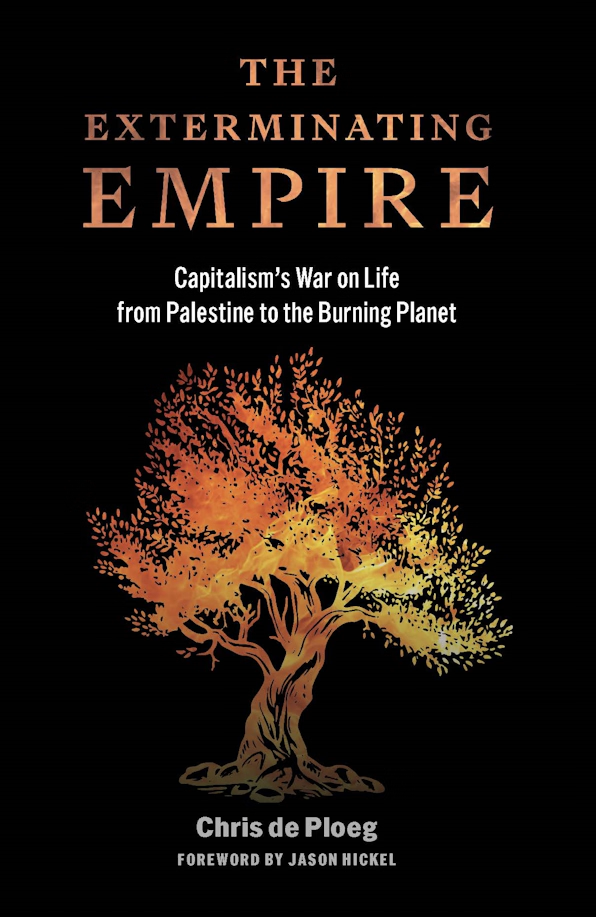
The main hall of Pakhuis de Zwijger, a converted warehouse on Amsterdam’s waterfront, was packed for the launch of The Exterminating Empire: Capitalism’s War on Life, From Palestine to the Burning Planet by Armenian-Dutch journalist, activist, and De Vonk organiser Chris Kaspar de Ploeg. The book is published in English by Monthly Review Press and in Dutch by EPO as De hel op aarde. De Ploeg co-founded the decolonisation organisation Aralez and is active in the revolutionary party De Vonk. His earlier books include The Great Colonial War trilogy and Ukraine in the Crossfire.
The evening was moderated by philosopher and trainer Harriët Bergman. On stage with de Ploeg was political economist Jason Hickel, who wrote the book’s foreword and supervised de Ploeg’s master’s thesis. Joining online was British-Palestinian surgeon Ghassan Abu-Sittah, Rector of the University of Glasgow, who worked the first 43 days of the genocide in Gaza’s Al-Shifa and Al-Ahli hospitals.
The book argues that genocide and ecocide are not tragic by-products of capitalism but fundamental features of it. Over two hours, the speakers discussed what this means for understanding Gaza and for organising against the system that produced it.
Palestine as the entry point
De Ploeg began with the current political situation. For the first time in decades, he said, the Netherlands is seeing a return of mass politics, driven by the livestreamed destruction of Gaza. Some 200,000 people recently marched in Amsterdam, even under what he called a “fake ceasefire”. Yet many of them experience Gaza as a baffling double standard: how can leaders who preach human rights and free speech do nothing?
The book is written to answer that confusion. What is happening, de Ploeg argued, “is not some crazy exception”. It was predictable, built into the logic of capitalism and imperialism. Once people see that, they can connect struggles for housing, against militarisation and against climate breakdown with the liberation of Palestine, and organise accordingly. He pointed to the 2023 Amsterdam climate march, where Palestinian voices were cut from the main stage, as what happens when movements refuse to make those connections.
Genocide as spectacle
Abu-Sittah said the book’s achievement is to treat the genocide in Gaza not as an event but as “the starting point for a new historical phase”. What sets it apart from other genocides of this century, he said, is that it is performed in the open. Rather than hiding bodies, Israel left the bodies of more than 400 people in shallow graves in the forecourt of Al-Shifa hospital, to be found. It chose Al-Ahli, a hospital linked to the Anglican church, for its first hospital massacre.
The book asks, Abu-Sittah said, what we must unlearn from 70 to 80 years of liberal narrative about the rule of law and human rights. These were accommodations that Western colonialism once needed and no longer does. Going beyond Patrick Wolfe’s settler-colonial “logic of elimination”, de Ploeg draws on economist Ali Kadri’s work on capitalism’s accumulation of waste: the consumption of environments and of human lives as a way of producing value. Abu-Sittah sees the same logic in the global North, where austerity has opened a life-expectancy gap of 10 to 15 years between rich and poor. He called this the social murder of populations that capital now treats as superfluous.
The killing is meant to be seen. The message to the global South, he said, is: do what you are told, or this will be done to you.
The lynching analogy
In the book, de Ploeg compares Gaza to lynching in the United States, and he explained the comparison on stage as well. In 1951, the African American civil rights lawyer and communist William Patterson presented the petition We Charge Genocide to the United Nations. Patterson estimated around 10,000 lynchings. These were public spectacles, attended by families and neighbours. But he rested his genocide charge on something larger: the structural violence of poverty wages and shortened lives, which he estimated caused some 200,000 excess deaths in just a few years.

The lynchings served that wider system, de Ploeg explained. They terrorised people into accepting working conditions that would otherwise be intolerable. “That is exactly the function of the lynching of Gaza,” he said. “It is a spectacle for the world to show the global South: this is exactly what happens if you step out of line.”
Hickel added that the spectacle is also aimed at audiences in the North, to desensitise us and prepare us to accept it when the next liberation movement is crushed. Every time we scroll past an atrocity and move on, he warned, we are being dehumanised too, and that must be resisted.
Why now?
Why is the violence so open now? De Ploeg answered with reference to his earlier work on the Second World War. Fascism rose in Italy and Germany where strong revolutionary movements threatened capital. Today the threat comes mainly from the global South. The rise of China and the growing ability of Southern countries to demand better wages and environmental standards squeeze Western profits. Violence is one of the last arenas where the US and its allies still dominate. This explains the massive militarisation, the aggression from Yemen to Libya to Iran, and decades of cosmetic climate policy that was never meant to work.
The liberal façade no longer holds, he argued. He recalled Aimé Césaire’s “boomerang”, the colonial violence that returned to Europe as fascism, and warned that the violence normalised in Gaza will eventually turn inward.
There is an alternative
Playing devil’s advocate, Bergman put to him the line that capitalism is at least the least-bad system. Hickel rejected the argument. In a world of ecological overshoot, genocidal war and billions facing food insecurity while they produce the world’s wealth, anyone who calls this the best of all possible worlds “has to be absolutely crazy”.
Markets, trade and business long predate capitalism, he pointed out. What defines capitalism is that it is profoundly undemocratic: those who produce the value have no say over what is produced or how the surplus is used, and production serves capital accumulation, not human needs. The alternative is to extend democracy into the economy, bringing investment and production under democratic control. Housing for all and renewable energy, he said, are “not difficult problems to solve, comrades”. “We live in a shadow of the world we can have.”
De Ploeg cited research by Hickel and colleagues estimating that about 30 percent of today’s global productive capacity would give everyone on Earth a good life, including healthcare, education, heating, cooling and communications. He also explained why renewables, though now cheaper than fossil fuels, remain less profitable. Anyone can put a solar panel on a roof, but an oil field needs vast capital and state connections, which allows monopoly and high returns. The obstacle, he said, is the profit motive, not technology.
From protest to power
Strategy is the subject of the book’s longest chapter, and it took up much of the discussion. The 2003 marches against the Iraq war were the largest demonstrations in human history, and the invasion still went ahead. Demonstrating, de Ploeg said, is ultimately asking. Movements must make the ruling class feel it in their wallets: strikes, worker power, and durable organisation that grows rather than dissipating after each march.
He argued for non-reformist reforms: fight for higher minimum wages and against austerity, but frame each win as a stepping stone, never a settlement with corporations that remain the enemy. He described the Belgian transport union that refused to handle arms shipments to Israel in the first months of the genocide. Its leader told him that 80 percent of the work is local struggle over wages and conditions, but once workers are politicised and organised, they can take the bigger steps. Anti-imperialism, de Ploeg said, is hollow if it remains an intellectual exercise.
Hickel, drawing on Vincent Bevins’ If We Burn, reflected on 15 years of mass uprisings that brought millions onto the streets but failed to take power, or left a vacuum filled by worse forces. He concluded that protest is not enough. “I’m not prepared to spend the rest of my short life just protesting. I want to win power for all of us.” He praised the Workers’ Party of Belgium (PTB-PVDA), a significant revolutionary party that has built a mass base in the working class while keeping its ideological clarity and discipline. In the Netherlands he pointed to De Vonk and a new democratic ecosocialist formation as efforts in the same direction.
Asked whether raising the topic of Palestine makes organising messages too complicated, de Ploeg argued for layers of communication. Simple, populist messaging on bread-and-butter issues reaches the mass audience, and deeper political training follows as people move into the organisation. Simplifying does not mean shelving Palestine. In working-class migrant neighbourhoods, he said, you won’t be taken seriously without it. What matters most is not clicks or seats but organisational power, because change comes explosively and unexpectedly, and typically not incrementally, and only the organised can seize the moment.
The imperialism debate
The Q&A turned to China, Russia and Iran. Is imperialism unique to the West? One questioner challenged a passage in the book calling theories of Chinese or Russian imperialism distractions, citing Marxist critiques from the South of Chinese capital in Latin American mining.
Hickel answered with world-systems analysis. Accumulation in the core depends on cheap labour and resources from the periphery, enforced by counterinsurgency against sovereignty movements and backed by some 800 US military bases. Whatever criticisms one has of China’s border disputes or Iran’s regional role, he said, they are of a different character. Stretch the word imperialism to cover them and it loses its meaning.

De Ploeg added figures. He cited a Tricontinental estimate that the US-led bloc accounts for about 75 percent of global military spending, and his own calculation that more than 90 percent of the profits of the world’s 100 most profitable private corporations go to the imperial core. Measured in labour hours, land, energy and materials, the drain from South to North is enormous, and middle-income countries such as China lose far more to the core than they gain from unequal trade with poorer countries. Not calling a state imperialist, he stressed, does not mean denying oppression there or withholding solidarity from those resisting it. Nor should such disagreements divide the movement: “Our primary responsibility is dismantling the war machine and the imperialism right here.”
What should people do on leaving the room, was a central question. Join an organisation, de Ploeg said. Any serious one will do, and you learn by doing. And don’t silo politics: talk to colleagues, neighbours and family over Christmas dinner, because people trust someone they know more than any professor or a newspaper.
Lessons for Australia
These arguments apply directly to Australia. Australia is not a bystander to the core’s war machine but part of it: Pine Gap, AUKUS, and local manufacturers supplying parts to the global F-35 program whose jets Israel flies over Gaza.
Australia has also seen huge Palestine mobilisations, including the mass march across the Sydney Harbour Bridge in August 2025. Here too, the question is how to turn those numbers into lasting organisation, rooted in workplaces and communities, able to put real pressure on the system.
Dismantling imperialism “right here” means confronting Australia’s role in the US alliance.

The olive tree
The evening closed with poetry. Accompanied by his brother Max on the Armenian duduk, de Ploeg read a poem rooted in his family’s history. His great-grandfather came from Zeitun, whose name means olive. It was one of the few Armenian towns to mount armed resistance during the 1915 genocide. Some survivors of the death marches into the Syrian desert, he noted, ended up in Palestine, only to be uprooted again in the Nakba. Today, Azerbaijani oil that fuels Israel’s war flows through pipelines crossing those same bloodlands.
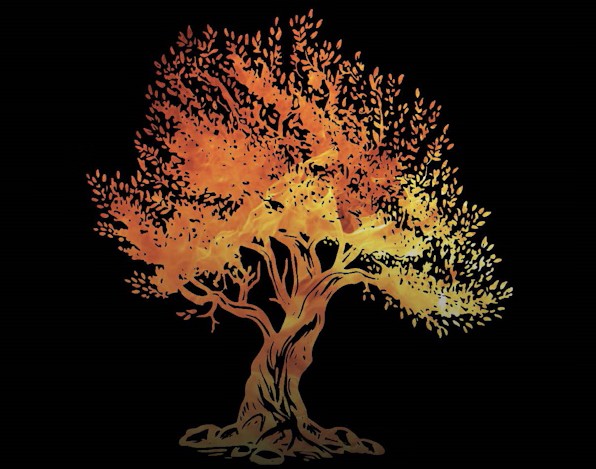
He framed the poem with Ghassan Kanafani’s image of imperialism as a body laid over the whole world: strike it anywhere, and you serve the world revolution. The olive tree on the book’s cover, a symbol of Palestinian steadfastness, stands for the same idea: these struggles are connected.
The Exterminating Empire: Capitalism’s War on Life, From Palestine to the Burning Planet by Chris Kaspar de Ploeg, with a foreword by Jason Hickel, is published by Monthly Review Press.


Leave a Reply